Showing posts with label New York Times. Show all posts
Showing posts with label New York Times. Show all posts
Wednesday, May 03, 2017
Dubrow's in the NY Times again
Marcia Bricker Halperin has taken many photos of Dubrow's - as well as many other landmarks of NYC - and her work is featured in the New York Times. Dubrow's referenced, as well as many other great NYC eateries. Check it out!


Saturday, April 16, 2016
James Madison High
In this old post, I shared a photo Marcia Bricker Halperin sent me from James Madison High School. Today I found in the depths of my computer files an article I never blogged that made reference to a Madison High School reunion in Beverly Hills, which included this great quote:
"Once you're from Brooklyn, you're always from Brooklyn, Richard Bock, Class of 1951, told his former schoolmates, seated at tables labeled to conjure memories: Dubrow's Cafeteria, Plum Beach, The Avalon Theater, Barney's Poolroom, Ocean Ave."
(Robin Brantley, "Beverly Hills Brooklynites," New York Times)
"Once you're from Brooklyn, you're always from Brooklyn, Richard Bock, Class of 1951, told his former schoolmates, seated at tables labeled to conjure memories: Dubrow's Cafeteria, Plum Beach, The Avalon Theater, Barney's Poolroom, Ocean Ave."
(Robin Brantley, "Beverly Hills Brooklynites," New York Times)
Sunday, July 26, 2015
Bernie Sanders hailed from Brooklyn in the Dubrow's era
A New York Times article
about a contemporary politician gave a shout out to Dubrow's Cafeteria
today! Apparently Democratic presidential candidate Bernie Sanders hails from
Brooklyn and lived close to the King's Highway location growing up.
The one detailed reference to Dubrow's comes with this strange line: "While others would eat pizza at Louis Gino’s, hang out at the Avalon Tearoom or avoid Dubrow’s Cafeteria after school, Mr. Sanders’s free time was spent on the track."
Why were people avoiding Dubrow's after school? Thoughts?
The one detailed reference to Dubrow's comes with this strange line: "While others would eat pizza at Louis Gino’s, hang out at the Avalon Tearoom or avoid Dubrow’s Cafeteria after school, Mr. Sanders’s free time was spent on the track."
Why were people avoiding Dubrow's after school? Thoughts?
Wednesday, January 30, 2008
Amoeba-like architecture
Found this in another New York Times article:
"It is no accident that it took more than a generation for Art Deco architecture to be appreciated, and similarly, this is why such 50's extravaganzas as the Fontainebleau Hotel in Miami Beach seem far less disturbing now than when they were new. It is not perverse taste, it is that they have become a part of the landscape we expect to see, and thus derive a curious kind of comfort from. So, too, with such an oddity as the interior of Dubrow's Cafeteria on Seventh Avenue in the garment district, which has those swirling, amoebalike shapes characteristic of 50's interiors. I walked past it the other day and was shocked to realize how that room, long an object of derision, is beginning to take on a certain appeal."
(Paul Goldberger, New York Times, July 30, 1981)
It's interesting to go back and see how differently things were perceived at different times. I don't think people would think the architecture at the Dubrow's in Manhattan is particularly unusual today. But clearly back then, at least this guy thought it was odd. And of course this is what he's saying - but now, over twenty years later, I think this just proves his point even more.
"It is no accident that it took more than a generation for Art Deco architecture to be appreciated, and similarly, this is why such 50's extravaganzas as the Fontainebleau Hotel in Miami Beach seem far less disturbing now than when they were new. It is not perverse taste, it is that they have become a part of the landscape we expect to see, and thus derive a curious kind of comfort from. So, too, with such an oddity as the interior of Dubrow's Cafeteria on Seventh Avenue in the garment district, which has those swirling, amoebalike shapes characteristic of 50's interiors. I walked past it the other day and was shocked to realize how that room, long an object of derision, is beginning to take on a certain appeal."
(Paul Goldberger, New York Times, July 30, 1981)
It's interesting to go back and see how differently things were perceived at different times. I don't think people would think the architecture at the Dubrow's in Manhattan is particularly unusual today. But clearly back then, at least this guy thought it was odd. And of course this is what he's saying - but now, over twenty years later, I think this just proves his point even more.
Friday, December 14, 2007
Where Dubrow's Used To Be

I visited the site of the Manhattan Dubrow's this fall when I was in New York City. When I came home, I found this article which referenced when the Offtrack Betting place opened up where it used to be.
"With a little luck, a new offtrack betting branch will open this fall in mid-Manhattan. But before the first $2 bet is placed, the Offtrack Betting Corporation will have spent $739,000 in rent for a branch that took almost two years to open.
Present and former officials of the agency clash over who is responsible for the delays in opening the branch at Seventh Avenue and 38th Street, on the site of the old Dubrow's cafeteria. But the officials, from two OTB administrations involved in the project, agree on one point: the abnormal costs will reduce the OTB's overall profits this year and the revenues it can give the city."
(New York Times, April 9, 1992)
This is a cool sculpture currently found in the area which pays homage to the Jewish garment workers of yore.

Monday, October 01, 2007
A walk through the garment district
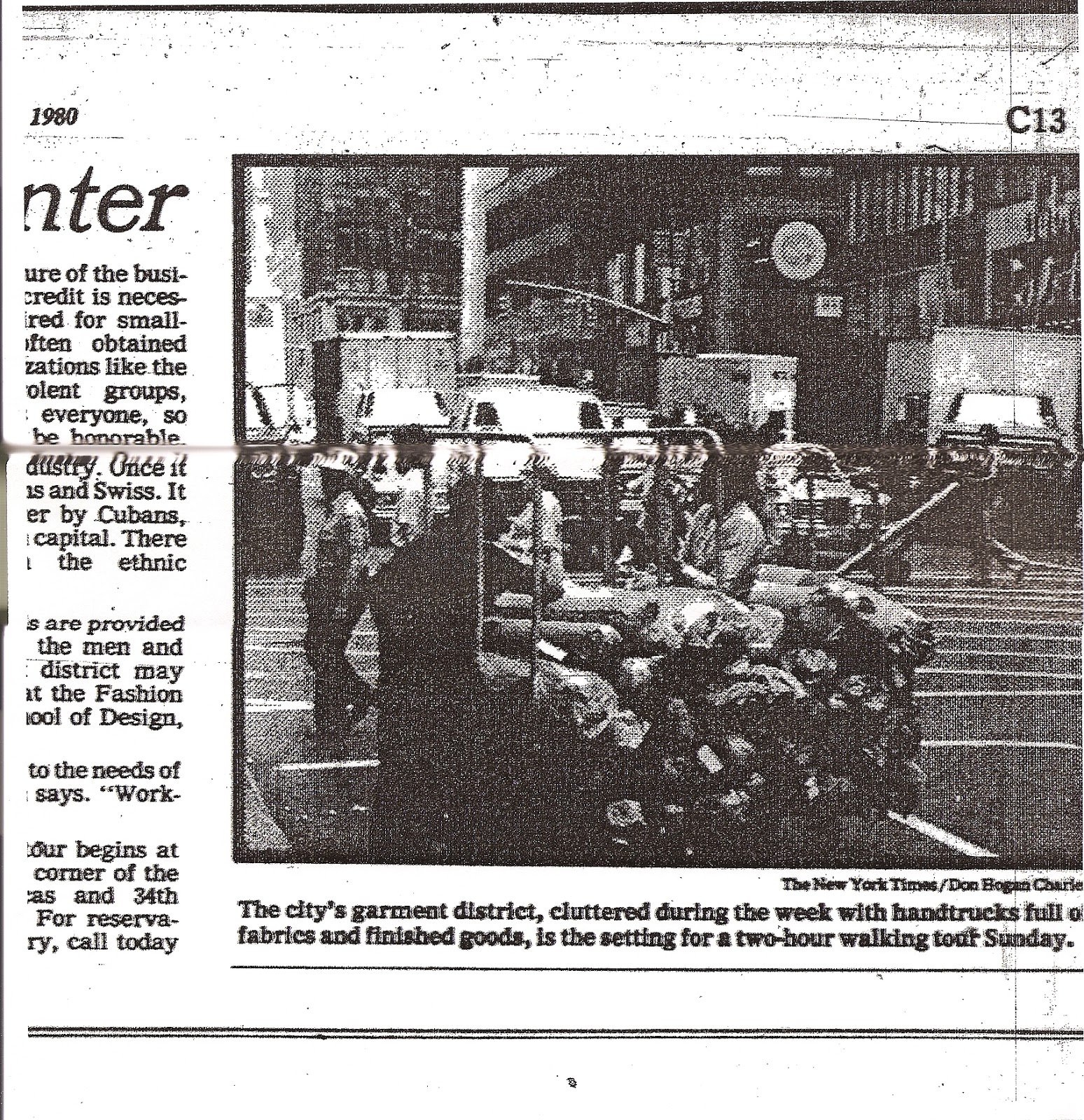
This picture comes from an article entitled "An Unhurried Walk in the Garment Center" by Jennifer Dunning. It is an interesting piece about a walking tour which was conducted in New York's garment district in 1980. Notice Dubrow's Cafeteria in the background - you can see part of the sign in the upper right corner.
Among other things, the article talks about how Dubrow's fit into the landscape of the garment district:
"The garment district is not only concentrated but also compartmentalized...'The district is more important as a display and distribution area than a major manufacturing area,' (James) Shenton saysm pointing up to a sooty Gothic-style emporium devoted largely to designer samples. 'Much of the manufacturing is done now in New Jersey, Pennsylvania, and North Carolina, though there is a revitalization of small-scale units of productions with the move back of Chinese to Chinatown and to Greeks to Astoria'...everything can be bought, it seems on Seventh Avenue, from "absolutely the best chocolate chip cookies in New York to holidays in Rumania.
On the corner of 38th Street alone, the fames Dubrow's Cafeteria and Lou Siegel's restaurant stand cheek by jowl with the Spanish Taverna. And each block has the most astonishing number of fast food restaurants, which suggests the enormous concentration of people here. A quarter of a million to 300,000 people pass through this area in the course of a normal workday."
(New York Times, Friday, July 11, 1980)
Tuesday, September 25, 2007
President Carter in front of Dubrow's

There's no article to accompany this image, but you can see that behind President Carter is part of the Dubrow's sign.
The caption for this article, which appeared on the front page of the Friday, October 31, 1980 edition of the New York Times, reads: "Carter ends New York Campaign. President Carter responding to union workers at rally in city's garment district."
Monday, September 24, 2007
A Cafeteria of Refinement
This is an ad from 1954. I didn't even realize Dubrow's advertised. Thanks to Marcia Bricker for this great find!

What's cool is now we also have a definitive answer as to when the King's Highway Dubrow's opened: 1939.

What's cool is now we also have a definitive answer as to when the King's Highway Dubrow's opened: 1939.
Sunday, September 23, 2007
Governor candidate stumps at Dubrow's
Well, it's been a long time since I updated this blog. I still have a couple New York Times articles left to post, but I finally made it to the Brookline Public Library, where I was able to track down a couple original copies on microfiche. The online New York Times archive wouldn't let me move the images in some of the articles, so I couldn't put them into a usable format to share here.

This one is of Hugh Carey, in front of the Manhattan Dubrow's. He was a Representative and a Democratic candidate for governor in 1974. The other photo is of another Democratic candidate (Howard J. Samuels) in Brooklyn. Excerpted from the accompanying article by Frank Lynn:
"Mr. Carey, for his garment center rally in front of Dubrow's Cafeteria at Seventh Avenue and 38th Street, had such leading Democrats as former governor Averell Harriman, former mayor Robert F. Wagner, and Mrs. Edith Lehman, widow of the Senator. Mr. Carey noted that Presidents Roosevelt, Truman, and Kennedy had spoken on the same site as candidates."
(New York Times, September 6, 1974)
But the title of the article is "Rivals for Governor Get Small Crowds" - apparently both candidates attracted very small limited numbers, and several people who did participate apparently did so negatively - they chastised Samuels for not allegedly not having paid his taxes. Hugh Carey won the Democratic candidacy and the election and went on to serve as governor from 1975 to 1982.
Anyone know more about Carey's statement about former presidents Roosevelt and Truman speaking in front of Dubrow's? I had only heard people recall seeing Kennedy in front of Dubrow's.

This one is of Hugh Carey, in front of the Manhattan Dubrow's. He was a Representative and a Democratic candidate for governor in 1974. The other photo is of another Democratic candidate (Howard J. Samuels) in Brooklyn. Excerpted from the accompanying article by Frank Lynn:
"Mr. Carey, for his garment center rally in front of Dubrow's Cafeteria at Seventh Avenue and 38th Street, had such leading Democrats as former governor Averell Harriman, former mayor Robert F. Wagner, and Mrs. Edith Lehman, widow of the Senator. Mr. Carey noted that Presidents Roosevelt, Truman, and Kennedy had spoken on the same site as candidates."
(New York Times, September 6, 1974)
But the title of the article is "Rivals for Governor Get Small Crowds" - apparently both candidates attracted very small limited numbers, and several people who did participate apparently did so negatively - they chastised Samuels for not allegedly not having paid his taxes. Hugh Carey won the Democratic candidacy and the election and went on to serve as governor from 1975 to 1982.
Anyone know more about Carey's statement about former presidents Roosevelt and Truman speaking in front of Dubrow's? I had only heard people recall seeing Kennedy in front of Dubrow's.
Sunday, April 29, 2007
Another Dubrow's review
I'm going to have to get to the library soon and check out some of the articles I downloaded from the New York Times archives in microfiche form. There seems to be a problem with some of the images, so I can't upload them all. I'm not sure if it's a copyright issue or a quality issue. But meanwhile, I found another review of Dubrow's, this one by Mimi Sheraton:
"Dubrow's Cafeteria, 515 Seventh Avenue near 38th Street (221-6777), is a classic, with larger-than-life dairy dishes, delicatessen sandwiches and steam-table food more or less Jewish - East European in style. Breakfast, lunch, and dinner prices are moderate. The best bets are the egg dishes, cold plates, sandwiches, and the vegetables with pot cheese and sour cream. Closed Sunday." (New York Times, August 8, 1980)
"Dubrow's Cafeteria, 515 Seventh Avenue near 38th Street (221-6777), is a classic, with larger-than-life dairy dishes, delicatessen sandwiches and steam-table food more or less Jewish - East European in style. Breakfast, lunch, and dinner prices are moderate. The best bets are the egg dishes, cold plates, sandwiches, and the vegetables with pot cheese and sour cream. Closed Sunday." (New York Times, August 8, 1980)
Friday, March 30, 2007
Comparing Dubrow's to Bagel Nosh
In 1976, the New York Times published an article entitled "You Can't Judge a Bagel By the Decor Around It" about the new chain of bagel shops called Bagel Nosh. This Manhattan chain was apparently very successful - it spread as far away as California, and several copycat franchises popped up. It does not appear that the current California and Arizona company by the same name is related - according to their website they started in 1993.
In general the article is about Bagel Nosh, and not unlike some of the glowing descriptive articles written about Dubrow's at different times, but what I find very interesting is that the owner of Bagel Nosh compares his restaurant to Dubrow's:
"'If you look in here and compare our crowd to the people you see next door at Dubrow's,' (Thomas) Quinn said by way of explaining his Seventh Avenue and 38th Street location, 'you'll notice we get the women and girls while they get the rackpushers and more traditional garment district types.' Women, in fact, outnumber men at lunch in that location by about six to one and, in general, exhibit a sort of career girl fashion awareness in dress." (New York Times, August 31, 1976)
In general the article is about Bagel Nosh, and not unlike some of the glowing descriptive articles written about Dubrow's at different times, but what I find very interesting is that the owner of Bagel Nosh compares his restaurant to Dubrow's:
"'If you look in here and compare our crowd to the people you see next door at Dubrow's,' (Thomas) Quinn said by way of explaining his Seventh Avenue and 38th Street location, 'you'll notice we get the women and girls while they get the rackpushers and more traditional garment district types.' Women, in fact, outnumber men at lunch in that location by about six to one and, in general, exhibit a sort of career girl fashion awareness in dress." (New York Times, August 31, 1976)
Sunday, March 18, 2007
Metropolitan Diary
That's title of what looks like an article in New York Magazine (November 22, 1976). It's written by Tom Buckley, and it's a piece about life in New York City. I find this quote about Dubrow's very interesting:
"The Governor, one of the landmarks of the Garment Center, closed last month...Well, you can still catch up on the gossip of the salesmen and the cutters at Dubrow's, on 38th and Seventh. Just tilt your chair up at an interesting table (that's your reservation) and go get your soup."
I didn't know about tilting your chair up. It's those little details I love to hear.
"The Governor, one of the landmarks of the Garment Center, closed last month...Well, you can still catch up on the gossip of the salesmen and the cutters at Dubrow's, on 38th and Seventh. Just tilt your chair up at an interesting table (that's your reservation) and go get your soup."
I didn't know about tilting your chair up. It's those little details I love to hear.
Sunday, March 11, 2007
George Dubrow (1903-1956)
Found the list of obituaries offered for George Dubrow, who was manager of the Manhattan Dubrow's until his tragic, early death in a car accident:
"DUBROW - George. beloved husband of Fannie; devoted father of Irwin, Helene, and Leonard, loving son of Benjamin and Rose Dubrow; dear brother of Minnie Tobin, Lila Adler, Sylvia Kaplan, and Ruth Gruber. Services Wednesday, 1:30 PM, "The Riverside", Brooklyn, Ocean Parkway and Prospect Park. In lieu of flowers, contributions can be made to the Heart Fund or the Nephrosis Foundation.
DUBROW - George. Local 325 Cooks, Countermen, Soda Dispensers, Food Checkers Cashiers, and Assistants Union, its officers and members, mourn the loss of George Dubrow, employer of our members. A person of deep integrity, gracious charity, and liberal intent, his will be an enduring monument in the history of man's humanity to man. We express our sincere sympathy to the bereaved members of his family. May his soul rest in peace.
HARRY DALLES. President
ABE SILVERSTEIN. Secretary-Treas.
DUBROW - George. The Utica Parkway Street John Merchant's Association extends its heartfelt condolences to the Dubrow family. The good name of George Dubrow will long be remembered by his fellow merchants and the community.
BERNARD KESSNER, President.
DUBROW - George. The employes of Dubrow's Cafeteria mourn with deep sorrow the sudden and untimely passing of their beloved employer and friend, and extend to his bereaved family their sincere and heartfelt sympathy.
DUBROW - George. The Board of Trustees of Beth-El Hospital notes with sorrow the sudden passing of our dear friend and benefactor. Our sincere condolences to his bereaved family.
BENNE KATZ, President.
DUBROW - George. The Officers and Directors of the Chronic Disease Hospital note with deep regret the passing of George Dubrow. Heartfelt condolences to the bereaved family.
ISAAC ALBERT, President.
DUBROW - George. Temple Beth-El, Rockaway Park, sorrowfully announces the passing of its devoted member. Members please attend services.
JAMES J. WOLFSON, President.
DR. NATHAN KAPLAN, Secretary."
It is an indicator of how important George was to the community that his obituary was the only one with multiple listings.
"DUBROW - George. beloved husband of Fannie; devoted father of Irwin, Helene, and Leonard, loving son of Benjamin and Rose Dubrow; dear brother of Minnie Tobin, Lila Adler, Sylvia Kaplan, and Ruth Gruber. Services Wednesday, 1:30 PM, "The Riverside", Brooklyn, Ocean Parkway and Prospect Park. In lieu of flowers, contributions can be made to the Heart Fund or the Nephrosis Foundation.
DUBROW - George. Local 325 Cooks, Countermen, Soda Dispensers, Food Checkers Cashiers, and Assistants Union, its officers and members, mourn the loss of George Dubrow, employer of our members. A person of deep integrity, gracious charity, and liberal intent, his will be an enduring monument in the history of man's humanity to man. We express our sincere sympathy to the bereaved members of his family. May his soul rest in peace.
HARRY DALLES. President
ABE SILVERSTEIN. Secretary-Treas.
DUBROW - George. The Utica Parkway Street John Merchant's Association extends its heartfelt condolences to the Dubrow family. The good name of George Dubrow will long be remembered by his fellow merchants and the community.
BERNARD KESSNER, President.
DUBROW - George. The employes of Dubrow's Cafeteria mourn with deep sorrow the sudden and untimely passing of their beloved employer and friend, and extend to his bereaved family their sincere and heartfelt sympathy.
DUBROW - George. The Board of Trustees of Beth-El Hospital notes with sorrow the sudden passing of our dear friend and benefactor. Our sincere condolences to his bereaved family.
BENNE KATZ, President.
DUBROW - George. The Officers and Directors of the Chronic Disease Hospital note with deep regret the passing of George Dubrow. Heartfelt condolences to the bereaved family.
ISAAC ALBERT, President.
DUBROW - George. Temple Beth-El, Rockaway Park, sorrowfully announces the passing of its devoted member. Members please attend services.
JAMES J. WOLFSON, President.
DR. NATHAN KAPLAN, Secretary."
It is an indicator of how important George was to the community that his obituary was the only one with multiple listings.
Sunday, March 04, 2007
Richard Peck quote
Author Richard Peck wrote an article for the New York Times about Brooklyn, and Dubrow's gets a mention:
"If Flatbush has a southern frontier, it is King's Highway. The commerce along Flatbush Avenue is beginning to go to seed, but King's Highway is a vital retail area. There is the London Fruit Market and the 1940's glamour of Dubrow's Cafeteria. There is Perlson's for men's wear, featuring pearl-buttoned denim for Brooklyn cowboys."
(New York Times, April 29,1973)
The end of the article mentions his book Dreamland Lake, which may relate in someway to the article, which is a nostalgic/historical piece. But it is one of a series of articles that document the changes beginning to take place in Brooklyn, of which Dubrow's was a part.
"If Flatbush has a southern frontier, it is King's Highway. The commerce along Flatbush Avenue is beginning to go to seed, but King's Highway is a vital retail area. There is the London Fruit Market and the 1940's glamour of Dubrow's Cafeteria. There is Perlson's for men's wear, featuring pearl-buttoned denim for Brooklyn cowboys."
(New York Times, April 29,1973)
The end of the article mentions his book Dreamland Lake, which may relate in someway to the article, which is a nostalgic/historical piece. But it is one of a series of articles that document the changes beginning to take place in Brooklyn, of which Dubrow's was a part.
Tuesday, February 20, 2007
Leo Martin in the news again
Very interesting. A year later, Leo Martin shows up in the New York Times again, but this time with the headline: "Four Food Dealers Held as Bribers."
"Operators of a cafeteria and three bakeries were arrested yesterday on charges of offering bribes to health inspectors to avoid the notoriety of appearing on the "dirty restaurant list" that warns the public of health violations, according to the complaint." (New York Times, November 17, 1971)
Apparently, at four different restaurants, the owners offered between $10 and $50 to inspectors in order to avoid flunking their food inspections. The deputy commissioner at the time, David Dorsen, was quoted as saying that this is the first time charges have been pressed against anyone attempting to offer bribes, and the law making restaurants who don't pass inspection public went into effect in July of 1971. It sounds like this was a case of setting the standard for other restaurants - i.e. take this seriously, don't try and buy your way out of these new regulations.
What's interesting, though is that it goes on to mention that all the restaurants had previously come up with a clean inspection:
"Previously, the four businesses cited, including Dubrow's, the popular cafeteria in the garment district, had been given clean bills of health, with no ciolations (sic) cited by H.S.A inspectors, who are known as "sanitarians," Mr. Dorsen said....The four men arrested and charged with bribery and giving unlawful gratuities were identified as Leib Braunfeld, 52, of Gertel Bakery, 53 Hester Street, charged with a $10 bribe offered on November 3; Herb Geller, 26, of Original Royal Bakery, 237 West 72nd Street, charged with offering a $20 bribe on November 13; Leo Martin, 56, of Dubrow's Cafeteria, 515 Seventh Ave, charged with offering a $50 bribe on November 14; and Adolph Mersberg, of Mersberg Bakery, 64-00 Metropolitan Avenue, Queens, with the complaint listing a $10 bribe offered on October 25. " (Ibid.)
It was probably a pretty minor incident, in the grand scheme of things, but it does raise some questions - why would Dubrow's not pass that year, when previously it had? Is it just a coincidence that it comes a year after Leo Martin's big push for increased productivity, or did he sacrifice some standards to get there?
"Operators of a cafeteria and three bakeries were arrested yesterday on charges of offering bribes to health inspectors to avoid the notoriety of appearing on the "dirty restaurant list" that warns the public of health violations, according to the complaint." (New York Times, November 17, 1971)
Apparently, at four different restaurants, the owners offered between $10 and $50 to inspectors in order to avoid flunking their food inspections. The deputy commissioner at the time, David Dorsen, was quoted as saying that this is the first time charges have been pressed against anyone attempting to offer bribes, and the law making restaurants who don't pass inspection public went into effect in July of 1971. It sounds like this was a case of setting the standard for other restaurants - i.e. take this seriously, don't try and buy your way out of these new regulations.
What's interesting, though is that it goes on to mention that all the restaurants had previously come up with a clean inspection:
"Previously, the four businesses cited, including Dubrow's, the popular cafeteria in the garment district, had been given clean bills of health, with no ciolations (sic) cited by H.S.A inspectors, who are known as "sanitarians," Mr. Dorsen said....The four men arrested and charged with bribery and giving unlawful gratuities were identified as Leib Braunfeld, 52, of Gertel Bakery, 53 Hester Street, charged with a $10 bribe offered on November 3; Herb Geller, 26, of Original Royal Bakery, 237 West 72nd Street, charged with offering a $20 bribe on November 13; Leo Martin, 56, of Dubrow's Cafeteria, 515 Seventh Ave, charged with offering a $50 bribe on November 14; and Adolph Mersberg, of Mersberg Bakery, 64-00 Metropolitan Avenue, Queens, with the complaint listing a $10 bribe offered on October 25. " (Ibid.)
It was probably a pretty minor incident, in the grand scheme of things, but it does raise some questions - why would Dubrow's not pass that year, when previously it had? Is it just a coincidence that it comes a year after Leo Martin's big push for increased productivity, or did he sacrifice some standards to get there?
Saturday, February 17, 2007
"Dubrow's is no ordinary cafeteria"

In this article, about a year after the death of Irwin Dubrow, we find out what happened to the Manhattan Dubrow's that Irwin ran for many years:
"Leo Martin got in an awful rut a while back. Like any other businessman in this inflationary era, his costs were galloping upward and his profitability - indeed the very existence of the cafeteria he operates at 515 Seventh Avenue and 38th Street - was threatened. This was no small matter to him because he not only operates Dubrow's cafeteria in the garment district, but since last October he has owned 30 percent. "Every time my costs went up, I would try and pass it on to the customer. Each time I raised my prices, I served fewer and fewer customers," he explained.
Business dropped from 5,500 customers a day to somewhere between 4,300 and 4,600 by the third week in May. We were starting to lose money for the first time since I took over full management last October on the death of the grandson of the founder," he said. "
(New York Times, October 26, 1971)
The article goes on to give us a good detail about Mr. Martin, as well as the history of the changes in owners and managers over the years:
"The other Dubrow cafeteria, at King's Highway and East 16th street, is owned by a relative of the founders. It's a separate business. Mr. Martin was no newcomer to the business. He began as an assistant manager in the Dubrow cafeteria on King's Highway in 1939. He had been general manager successively of three Dubrow cafeterias, the last one being the Seventh Avenue one. He left Dubrow's in 1959 to become general manager for the Arthur Maisel restaurants. When the Maisel restaurants liquidated, the Dubrows asked Mr. Martin to come back. That was in October, 1968, and he's been there ever since. " (Ibid.)
The article is not just a character piece about Leo Martin, however, as it goes on to try to understand the realities facing the cafeteria in New York City:
"Mr. Martin was not only in a restaurant where business was falling, he was in an industry that failed to adjust. At one time, there were perhaps 300 cafeterias in the city as big as the Dubrows Seventh Avenue one - it seats 450 - now there are 25 of them and many are in trouble.
"I realized the fact that the cafeterias had outpriced themselves and were not competitive with the average man's eating place, " Mr. Martin recounted. "Hamburger stands, pushcarts in the street, small coffee shops, and even some medium-priced restaurants were all outselling us."
It was easy for Mr. Martin to fall into the trap of raising prices. Dubrow's is no ordinary cafeteria. At dinner, a dessert cart serves the tables directly. The pastries on that cart art all produced on the premises. Dubrow's employs 11 bakers who make Vienna rolls, stangell, a salt stick, pletsl, a thin crisp roll garnished with on-" (Ibid.)
Here the article continues on another page that is apparently not included in the download. But it picks up shortly thereafter and explains how Leo Martin helped Dubrow's survive when other cafeterias were faltering:
"...Mr. Martin naturally expected to get good prices. Yet the fact remained that, while quality was high, the customers just weren't coming into the restaurant.
Of all things, New York City's extending of a 7 percent sales tax to meals below a dollar proved to be fortuitous. The customers resented it naturally, and this didn't help business. Mr. Martin, a 55-year-old slim man with wavy black hair and a mustache, knew he had to do something drastic to regain his business. It wouldn't be easy. The garment district, in which the restaurant was centered, had become more and more depressed...He decided to use one of the oldest gimmicks in merchandising - the loss leader. What's more, he tied it to the 7 percent "hot dog" tax, as the levy, which starts at 15 cents, has been called.
He explained: "We decided to absorb the 7 percent tax on a selected list of specials on which we reduced our prices substantially. For example, a hamburger and coffee at lunch, which used to bring $1.02 including the 7 percent tax, we now featured for 69 cents."
...This kind of special is enough to make any restaurant man apprehensive. Mr. Martin admits that, if his customers bought nothing else, the specials would put him out of business. It didn't work that way - about 25 percent of the customers are ordering specials - and it almost never does, he explained..."We have reacquainted old and new customers with Dubrow's and our tremendous selection of food. Consequently, we have people coming in daily who eat the special once a week or twice a week - but not all the time. The rest of the week, they buy regular items." (Ibid.)
Essentially, Dubrow's saved itself for another decade and a half, while other cafeterias were closing, by building on its strength - loyal customers.
"The reason production is so important to Dubrow's is that an establishment as big as this must have a large basic production crew. The solution was increase dollar volume without increasing the payroll. When the specials began on September 22, volume soared immediately, Mr. Martin said, adding: "We're now serving about a thousand customers a day more than we did before the loss leaders. Our average day - we're open 16 hours, until 10 PM, we serve breakfast, lunch, and dinner - brings in between 5,500 and 5,600 customers a day"..." (Ibid.)
Mr. Martin goes on to crunch the numbers - I presume this article was written for the business section of the New York Times, as it has a decidedly business feel. I also imagine that the publicity garnered from the article didn't hurt business, either, so that was a good business move as well. He also goes on to note that not all the employees were so happy about the changes, as for them, it meant more work and not any more money.
Friday, February 16, 2007
Irwin Dubrow
Among the articles about Dubrow's I found in the New York Times database, I also found Irwin Dubrow's obituary. In the copy available to download, it looks like part of the header has been cut off. It reads "Irwin Dubrow, 39, Dead;" and the presence of the semicolon indicates more text, as do the stray black marks found underneath. But mostly it's just white space, so I don't know what the rest of the header read.
The obituary goes on to report his death, with no mention of how he died:
"Mr. Dubrow headed Dubrow's, which operated a cafeteria at 515 Seventh Avenue, near 39th street, and another on 35th street off Seventh Avenue. He also operated Alfie's a bar and grill at Third Avenue and 74th Street, and a restaurant on King's Highway in Brooklyn.
He was a director of the Karen Horney Clinic and a director of Affiliated Restaurateurs, Inc.
He leaves his wife, the former Ann Tuck, two daughters, Joanne and Barbara, a sister, Mrs. Helene Grossman, and his mother, Mrs. Fannie Dubrow Rubin. "
(New York Times, October 6, 1970)
A little backstory: Irwin Dubrow, who was the grandson of Benjamin Dubrow, killed himself. I am guessing that that is what is in the rest of the headline, though I am not sure if it was intentionally blotted out. I know that Dubrow's was closed for a little while following his suicide, which is understandable since it was a family crisis, both personally and in terms of the business.
I did not, however, know that there was another cafeteria owned by the family in Manhattan, nor did I know how many different jobs Irwin was doing at once. Was the "other restaurant" on King's Highway actually Dubrow's? Or did the family own a different restaurant on King's Highway later on? And Karen Horney clinic? Does that mean he was a social worker on top of being a businessman? I know Joanne, his daughter, has chimed in on this blog at times, so perhaps she will add some of her thoughts. Also, Irwin left behind another brother, Leonard, who for unknown reasons is not mentioned in the obituary.
The obituary goes on to report his death, with no mention of how he died:
"Mr. Dubrow headed Dubrow's, which operated a cafeteria at 515 Seventh Avenue, near 39th street, and another on 35th street off Seventh Avenue. He also operated Alfie's a bar and grill at Third Avenue and 74th Street, and a restaurant on King's Highway in Brooklyn.
He was a director of the Karen Horney Clinic and a director of Affiliated Restaurateurs, Inc.
He leaves his wife, the former Ann Tuck, two daughters, Joanne and Barbara, a sister, Mrs. Helene Grossman, and his mother, Mrs. Fannie Dubrow Rubin. "
(New York Times, October 6, 1970)
A little backstory: Irwin Dubrow, who was the grandson of Benjamin Dubrow, killed himself. I am guessing that that is what is in the rest of the headline, though I am not sure if it was intentionally blotted out. I know that Dubrow's was closed for a little while following his suicide, which is understandable since it was a family crisis, both personally and in terms of the business.
I did not, however, know that there was another cafeteria owned by the family in Manhattan, nor did I know how many different jobs Irwin was doing at once. Was the "other restaurant" on King's Highway actually Dubrow's? Or did the family own a different restaurant on King's Highway later on? And Karen Horney clinic? Does that mean he was a social worker on top of being a businessman? I know Joanne, his daughter, has chimed in on this blog at times, so perhaps she will add some of her thoughts. Also, Irwin left behind another brother, Leonard, who for unknown reasons is not mentioned in the obituary.
Wednesday, February 14, 2007
End of another New York cafeteria
Continuing the theme of understanding the demise of New York City's cafeterias, I found this article about the closing of another cafeteria, Garfield's, which was located at the corner of Flatbush and Church Avenues in Brooklyn. According to the article, it officially close on July 6, 1971, "after declining business had forced its demise."
The article goes on to reference the Dubrow's on Eastern Parkway:
"Garfield's, in its heyday, was known throughout Brooklyn, mentioned in the same breath with Dubrow's on Eastern Parkway and Utica Ave and Hoffman's on Pitkin and Saratoga Avenues, which are also gone."
(New York Times, July 25, 1971)
The article goes on to reference the Dubrow's on Eastern Parkway:
"Garfield's, in its heyday, was known throughout Brooklyn, mentioned in the same breath with Dubrow's on Eastern Parkway and Utica Ave and Hoffman's on Pitkin and Saratoga Avenues, which are also gone."
(New York Times, July 25, 1971)
Monday, February 12, 2007
Foreshadowing the end of Dubrow's
I found an article by Murray Schumach in the New York Times that talks about the decline in New York's cafeterias. It was written in 1969 - which is interesting to note because it means problems started for the cafeteria business quite early on. It also means Dubrow's survived the decline for a decade and a half, much longer than others in the city. Schumach writes:
"Affluence has already cannibalized more than two-thirds of those mirrored citadels that became symbols of the city and transferred the tempo of the subway to the stomach." (New York Times, August 18, 1969)
He goes on to quote customers and the owners of the Governor Cafeteria and the Belmore Cafeteria before talking about Dubrow's:
"And at Dubrow's, an equally successful cafeteria at Seventh Ave and 38th Street, the owner, Irwin Dubrow, grandson of the founder of the business, says: "A cafeterial can't pass along increased prices and wages the way other eating places do. A couple years ago we raised our price of coffee from 10 cents to 15. We were only doing what everybody else was doing. But we lost 1,500 customers a day and we still haven't gotten them all back."" (Ibid.)
He goes on to reference two Hector's Cafeterias, Garfield's, Dixon's, the King's Highway Dubrow's, the 167th Street Cafeteria, and the Concord as other currently surviving but struggling cafeterias. He doesn't reference the Eastern Parkway Dubrow's - I don't know if this means it had closed by now, or what.
He also interviews a customer in the Manhattan Dubrow's later in the article, and mentions Leo Martin, who came up earlier on this blog because his obituary mentioned working at Dubrow's:
"One recent afternoon, in the Manhattan Dubrow's, Charles Abbott, a salesman, was asked as he sat squeezed at a table among two strangers, why he liked cafeterias. He replied, "You get out quick. The price is right. And with such an output, you never get a stale sandwich."
Leo Martin, an executive at the cafeteria, says that a study showed that during the lunch hour the average customer was out in 19 minutes. At The Governor, the calculations show that...each of the 426 seats is turned over seven times between noon and 2 PM." (Ibid)
What's interesting about this is that it contradicts some of what readers have shared about liking so much about Dubrow's - the ability to "plunk down a quarter for a cup of coffee and sit all day" as my great-aunt Marian said.
"Affluence has already cannibalized more than two-thirds of those mirrored citadels that became symbols of the city and transferred the tempo of the subway to the stomach." (New York Times, August 18, 1969)
He goes on to quote customers and the owners of the Governor Cafeteria and the Belmore Cafeteria before talking about Dubrow's:
"And at Dubrow's, an equally successful cafeteria at Seventh Ave and 38th Street, the owner, Irwin Dubrow, grandson of the founder of the business, says: "A cafeterial can't pass along increased prices and wages the way other eating places do. A couple years ago we raised our price of coffee from 10 cents to 15. We were only doing what everybody else was doing. But we lost 1,500 customers a day and we still haven't gotten them all back."" (Ibid.)
He goes on to reference two Hector's Cafeterias, Garfield's, Dixon's, the King's Highway Dubrow's, the 167th Street Cafeteria, and the Concord as other currently surviving but struggling cafeterias. He doesn't reference the Eastern Parkway Dubrow's - I don't know if this means it had closed by now, or what.
He also interviews a customer in the Manhattan Dubrow's later in the article, and mentions Leo Martin, who came up earlier on this blog because his obituary mentioned working at Dubrow's:
"One recent afternoon, in the Manhattan Dubrow's, Charles Abbott, a salesman, was asked as he sat squeezed at a table among two strangers, why he liked cafeterias. He replied, "You get out quick. The price is right. And with such an output, you never get a stale sandwich."
Leo Martin, an executive at the cafeteria, says that a study showed that during the lunch hour the average customer was out in 19 minutes. At The Governor, the calculations show that...each of the 426 seats is turned over seven times between noon and 2 PM." (Ibid)
What's interesting about this is that it contradicts some of what readers have shared about liking so much about Dubrow's - the ability to "plunk down a quarter for a cup of coffee and sit all day" as my great-aunt Marian said.
Wednesday, February 07, 2007
Dubrow's as a community center
I found two articles from the 1960's, both of which reference Dubrow's as a center of political and community life in Brooklyn. The first one is about the Patrolmen's Benevolent Association rallying the community to vote 'yes' to eliminate the Civilian Complaint Review Board, claiming that "the existence of the board prevents policemen from taking appropriate action to fight crime." (New York Times, October 24, 1966) Apparently the language of the ballot measure was sufficiently confusing, because the article goes on:
"A yes vote bars civilians from serving. Thus anyone favoring the present board must vote no to support it. This produced bewilderment. In front of Dubrow's Cafeteria on King's Highway at 16th street, a campaign worker spoke in a mixture of Yiddish and English in an effort to clarify things for an elderly man."
This campaign hit up all the stops in Brooklyn - the article goes on to say that they made stops at Trump Village shopping center in Brighton Beach and Nathan's Famous before coming to Dubrow's, and from Dubrow's they planned another stop at the Brighton Beach Baths. The article also references a politician named Lindsay and blames much of the current political issues on him.
Two years later, Lindsay, who it turns out was the mayor at the time, is also booed in front of Dubrow's:
"At King's Highway and East 16th street in Brooklyn, the crowd was so vehemently anti-Lindsay over the school strike that (Senator Jacob) Javitz, a master at soothing angry crowds, said several times that there was no point in continuing since he could not be heard, even with a microphone.
"The Mayor is in a tough spot - it may even be his own fault," the Senator told a crowd that including angry teachers and parents outside Dubrow's Cafeteria. But just as he is jeered today, he may be cheered tomorrow.""
(Tolchin, M. "Lindsay Backlash Confronts Javitz." New York Times, October 17, 1968)
Anyone remember these particular political events? The theme is consistent with memories people have shared earlier on this blog about the King's Highway Dubrow's being a popular place for politicians to stump.
"A yes vote bars civilians from serving. Thus anyone favoring the present board must vote no to support it. This produced bewilderment. In front of Dubrow's Cafeteria on King's Highway at 16th street, a campaign worker spoke in a mixture of Yiddish and English in an effort to clarify things for an elderly man."
This campaign hit up all the stops in Brooklyn - the article goes on to say that they made stops at Trump Village shopping center in Brighton Beach and Nathan's Famous before coming to Dubrow's, and from Dubrow's they planned another stop at the Brighton Beach Baths. The article also references a politician named Lindsay and blames much of the current political issues on him.
Two years later, Lindsay, who it turns out was the mayor at the time, is also booed in front of Dubrow's:
"At King's Highway and East 16th street in Brooklyn, the crowd was so vehemently anti-Lindsay over the school strike that (Senator Jacob) Javitz, a master at soothing angry crowds, said several times that there was no point in continuing since he could not be heard, even with a microphone.
"The Mayor is in a tough spot - it may even be his own fault," the Senator told a crowd that including angry teachers and parents outside Dubrow's Cafeteria. But just as he is jeered today, he may be cheered tomorrow.""
(Tolchin, M. "Lindsay Backlash Confronts Javitz." New York Times, October 17, 1968)
Anyone remember these particular political events? The theme is consistent with memories people have shared earlier on this blog about the King's Highway Dubrow's being a popular place for politicians to stump.
Subscribe to:
Posts (Atom)