Jeff writes with recollections and a question about the Miami Beach Dubrow's Cafeteria. I know very little about this, but I thought I'd see if anyone else did. I'm pretty sure I remember going to Dubrow's on Lincoln Road, but honestly, I was so young (I was 12 in 1985 when the last Dubrow's Cafeteria closed for good) I could be mixing up Manhattan and Miami, since I went to both places at different times in my childhood.
Jeff writes:
"I found your blog site while trying to research the Dubrow's located on Lincoln Road in the 1950's through sometime in 1963 (?).
I'd moved to Miami Beach as a youngter when my family relocated from Brooklyn around October of 1963, and at that time the Dubrow's on Lincoln Road was closed and had a "Bankrupt" sign hanging on the inside of the doors. A couple of years later, the location reopened as "New Dubrow's, Inc."
Did your family reopen it, or was it run independent of them?
Also, a dear, departed friend of mine was in the sign business down here since 1948. He did work for the Lincoln Road Cafeteria - the original name of where Dubrow's ws located. Did the family purchase that location, or originally run it as the Lincoln Road Cafeteria?"
Also, Marcia has a question about the picture of Kennedy in front of Dubrow's:
"I believe this photo of Kennedy was taken on the 16th Street side in front of Craig's Bake Shops which was across the street from Dubrows. Maybe they had the rally on the side street or brought Kennedy into Dubrow's through the kitchen entrance which was there. Can Ms. Cohen confirm this? My mom says she remembers my Dad went to see Kennedy there that night. "
Friday, April 25, 2008


Thursday, April 10, 2008
Kennedy with Max Tobin

Sanda Bragman Cohen, the woman who mailed me the photos of Kennedy at the King's Highway Dubrow's, had this to say about the photos:
"They were taken by a photographer hired by Max Tobin who owned Dubrow's on Kings Highway. He is the man standing behind President Kennedy. His wife was Minnie Dubrow Tobin who was Sylvia Kaplan's sister. Minnie Tobin died in 1957. My mother, Mary Bragman, is the only woman in the picture. She married Max Tobin in 1968 when my father had been dead for four years. My father is the man that can only be partially seen standing behind Max Tobin. The photography studio was named Renard and it was located in Brooklyn. As far as I know the pictures were not copyrighted by anyone. They belonged to Max Tobin, because he paid for them. They were given to me by my mother just before she died. Until then they were in her home. The pictures were taken in October, 1960 when Kennedy was campaigning. Many politicians made a stop at Dubrows because it was the most popular place in that neighborhood (Flatbush), but I do not have any other pictures. The two men sitting next to Kennedy were Brooklyn politicians, and I used to know their names, but I have forgotten. Standing behind my mother, kind of in the shadows, is Carmine DeSapio (he is the man with the sunglasses) who was a powerful politician at the time. I remember that Kennedy wanted a steak and salad for dinner, which was provided for him. It was not the usual Dubrows food. I also remember that my mother was answering the special phones that had been connected for Kennedy and in that picture she is handing him a message from Robert Kennedy. My parents wanted me to have my picture taken with Kennedy, but I was fifteen and had a pimple, so I refused. Needless to stay I lived to regret that decision. However, I did wear a campaign button that said, "If I were 21 I would vote for Kennedy." I would have too!"
Tuesday, April 08, 2008
JFK campaigning at Dubrow's

Several other readers have talked about their recollections of JFK campaigning at the King's Highway Dubrow's. Reader Sanda Cohen has submitted a couple fabulous photos which commemorates this event. This is the first of those photos.
Wednesday, February 13, 2008
More reader feedback (Darryl)
I've been getting a bunch of emails from readers, which is just fabulous. I can follow the stats as to where people are when they're reading, but I have to hear from you to know WHO you are, and what Dubrow's means to you.
Darryl writes:
"My friend Marty and I would spend many a Friday night at Dubrow's on
Kings Highway. My particular favorite was the vegetable cream cheese
on a bagel. The counterman would dunk the bagel into a tray full of
chopped vegetables that would then stick to the cream cheese. One
night we met an elderly woman named Libby Siegel who had the peculiar
ability to spell any word backwards. We tried to trick her with extra
long words but she never missed.
When I was younger I did go the the Dubrow's on Eastern Parkway and
Utica. Unless I am mistaken, I drove by that corner about ten years
ago and saw a Dubrow's sign still hanging on the Utica Avenue side of
the restaurant. It was an art deco style possibly made of glass . It
was surrounded by all the billboards of the newer stores and was
barely viewable. I wonder if it is possibly still there.
If there are any artifacts around from the restaurant I would
certainly love to be able to get one. I did have one of those white
sailor type hats the countermen wore. The picture of the tray brought
back some memories.
Thank you. My life in Brooklyn during the fifties was a special time
for me and Dubrows was a nice part of it."
Darryl writes:
"My friend Marty and I would spend many a Friday night at Dubrow's on
Kings Highway. My particular favorite was the vegetable cream cheese
on a bagel. The counterman would dunk the bagel into a tray full of
chopped vegetables that would then stick to the cream cheese. One
night we met an elderly woman named Libby Siegel who had the peculiar
ability to spell any word backwards. We tried to trick her with extra
long words but she never missed.
When I was younger I did go the the Dubrow's on Eastern Parkway and
Utica. Unless I am mistaken, I drove by that corner about ten years
ago and saw a Dubrow's sign still hanging on the Utica Avenue side of
the restaurant. It was an art deco style possibly made of glass . It
was surrounded by all the billboards of the newer stores and was
barely viewable. I wonder if it is possibly still there.
If there are any artifacts around from the restaurant I would
certainly love to be able to get one. I did have one of those white
sailor type hats the countermen wore. The picture of the tray brought
back some memories.
Thank you. My life in Brooklyn during the fifties was a special time
for me and Dubrows was a nice part of it."
Friday, February 01, 2008
More reader feedback (Marty)
Received another email recently, this one from Marty:
Hi Eve,
I was taking a little trip down memory lane and decided
to google Dubrow's. Your great grandfather had a
great cafeteria. I frequented the Dubrow's on Kings
Highway in Brooklyn for many years with my friends.
We would meet late at night for something to eat after
we took home our girlfriends. Sometimes we would just
go there late on a Friday night if we had nothing else
to do. We were in our twenties, while most of the
people there were senior citizens. The seniors loved
it there. It was a place for them to go if they just
wanted to talk to someone. We would hang out and talk
for an hour or two before heading home. Dubrows had
the best rice pudding! I moved out of Brooklyn many
years ago, but still have fond memories of Dubrow's
After I got married, I found out that my wife's late
uncle was a counter man at Dubrow's for many years.
Thanks for the website. It brought back nice
memories.
Marty
Thank you, Marty, for reading and for sharing your memories! I love hearing from people.
Hi Eve,
I was taking a little trip down memory lane and decided
to google Dubrow's. Your great grandfather had a
great cafeteria. I frequented the Dubrow's on Kings
Highway in Brooklyn for many years with my friends.
We would meet late at night for something to eat after
we took home our girlfriends. Sometimes we would just
go there late on a Friday night if we had nothing else
to do. We were in our twenties, while most of the
people there were senior citizens. The seniors loved
it there. It was a place for them to go if they just
wanted to talk to someone. We would hang out and talk
for an hour or two before heading home. Dubrows had
the best rice pudding! I moved out of Brooklyn many
years ago, but still have fond memories of Dubrow's
After I got married, I found out that my wife's late
uncle was a counter man at Dubrow's for many years.
Thanks for the website. It brought back nice
memories.
Marty
Thank you, Marty, for reading and for sharing your memories! I love hearing from people.
Wednesday, January 30, 2008
A request from a reader (Joe)
I received an email from a reader. Joe asks about another cafeteria very close to Dubrow's:
Yes, it was called the "Famous Cafeteria" and it was very similar to Dubrows, but it was located in the Bensonhurst section of Brooklyn on 86th St. and now I see that it was located directly across from Dubrows...Maybe you can post a request in your blog?
Here's a quote from another Brooklyn Blog....
"And diagonally across the intersection from Dubrow's was the Famous, a dairy restaurant where delicious dishes like perrogies and sour cream were served. What would today's nutritionists say about that. Better yet, what would they say about "gribbinus" (transliteration), a delicacy made from fried chicken fat. "
http://www.geocities.com/buddychai2/Brooklyn/RememberWhen2.html
Anyone have any more information about Famous Cafeteria to help Joe out?
Yes, it was called the "Famous Cafeteria" and it was very similar to Dubrows, but it was located in the Bensonhurst section of Brooklyn on 86th St. and now I see that it was located directly across from Dubrows...Maybe you can post a request in your blog?
Here's a quote from another Brooklyn Blog....
"And diagonally across the intersection from Dubrow's was the Famous, a dairy restaurant where delicious dishes like perrogies and sour cream were served. What would today's nutritionists say about that. Better yet, what would they say about "gribbinus" (transliteration), a delicacy made from fried chicken fat. "
http://www.geocities.com/buddychai2/Brooklyn/RememberWhen2.html
Anyone have any more information about Famous Cafeteria to help Joe out?
Amoeba-like architecture
Found this in another New York Times article:
"It is no accident that it took more than a generation for Art Deco architecture to be appreciated, and similarly, this is why such 50's extravaganzas as the Fontainebleau Hotel in Miami Beach seem far less disturbing now than when they were new. It is not perverse taste, it is that they have become a part of the landscape we expect to see, and thus derive a curious kind of comfort from. So, too, with such an oddity as the interior of Dubrow's Cafeteria on Seventh Avenue in the garment district, which has those swirling, amoebalike shapes characteristic of 50's interiors. I walked past it the other day and was shocked to realize how that room, long an object of derision, is beginning to take on a certain appeal."
(Paul Goldberger, New York Times, July 30, 1981)
It's interesting to go back and see how differently things were perceived at different times. I don't think people would think the architecture at the Dubrow's in Manhattan is particularly unusual today. But clearly back then, at least this guy thought it was odd. And of course this is what he's saying - but now, over twenty years later, I think this just proves his point even more.
"It is no accident that it took more than a generation for Art Deco architecture to be appreciated, and similarly, this is why such 50's extravaganzas as the Fontainebleau Hotel in Miami Beach seem far less disturbing now than when they were new. It is not perverse taste, it is that they have become a part of the landscape we expect to see, and thus derive a curious kind of comfort from. So, too, with such an oddity as the interior of Dubrow's Cafeteria on Seventh Avenue in the garment district, which has those swirling, amoebalike shapes characteristic of 50's interiors. I walked past it the other day and was shocked to realize how that room, long an object of derision, is beginning to take on a certain appeal."
(Paul Goldberger, New York Times, July 30, 1981)
It's interesting to go back and see how differently things were perceived at different times. I don't think people would think the architecture at the Dubrow's in Manhattan is particularly unusual today. But clearly back then, at least this guy thought it was odd. And of course this is what he's saying - but now, over twenty years later, I think this just proves his point even more.
Monday, December 17, 2007
"Aspired to opulent excellence"
"When winter came, the candy stores and cafeterias replaced parks as forums to debate politics and art. People gathered at candy stores "to discuss politics and unionism." Local kids "made pocket change by hanging out at Leboff's candy store [one of five on Charlotte street], and calling people to the phone." Hoffman's Cafeterias on Pitkin, Flatbush, and Brighton Beach Avenues also entered the radical element. (Irving) Howe recalled that "in the winter, when the Bronx is gray and icy, there were cafeterias in which the older comrades, those who had jobs or were on WPA, bought coffee while the rest of us filled the chairs." Other cafeterias, like Dubrow's or Garfield's in Brooklyn, aspired to opulent elegance. Garfield's dubbed itself "a cafeteria of refinement." Located on the corner of Church and Flatbush Avenues, diagonally across from the Reformed Dutch Protestant Church, Garfield's boasted an interior decorated with mosaics done in Art Moderne style. Dubrow's, a dairy cafeteria, also served as a neighborhood meeting spot with its attractive location by the elevated station, on a shopping street like King's Highway."
(At Home In America: Second Generation New York Jews, by Deborah Dash Moore, 1981)
Now, a few questions about this. First, could Garfield's and Dubrow's had the same tagline to describe themselves? Because this post indicates that Dubrow's advertised itself as being "a cafeteria of refinement" - yet here it says Garfield's used that line.
Furthermore, this post indicates that the Dubrow's on King's Highway had a very modern decor, using mosaic. This is how the author (who cites a number of different sources for this particular passage, including the reputable Irving Howe) describes Garfield's. Could Garfield's and Dubrow's BOTH have had mosaic in their decor? Or is she mixing up Garfield's with Dubrow's?
(At Home In America: Second Generation New York Jews, by Deborah Dash Moore, 1981)
Now, a few questions about this. First, could Garfield's and Dubrow's had the same tagline to describe themselves? Because this post indicates that Dubrow's advertised itself as being "a cafeteria of refinement" - yet here it says Garfield's used that line.
Furthermore, this post indicates that the Dubrow's on King's Highway had a very modern decor, using mosaic. This is how the author (who cites a number of different sources for this particular passage, including the reputable Irving Howe) describes Garfield's. Could Garfield's and Dubrow's BOTH have had mosaic in their decor? Or is she mixing up Garfield's with Dubrow's?
Friday, December 14, 2007
Where Dubrow's Used To Be

I visited the site of the Manhattan Dubrow's this fall when I was in New York City. When I came home, I found this article which referenced when the Offtrack Betting place opened up where it used to be.
"With a little luck, a new offtrack betting branch will open this fall in mid-Manhattan. But before the first $2 bet is placed, the Offtrack Betting Corporation will have spent $739,000 in rent for a branch that took almost two years to open.
Present and former officials of the agency clash over who is responsible for the delays in opening the branch at Seventh Avenue and 38th Street, on the site of the old Dubrow's cafeteria. But the officials, from two OTB administrations involved in the project, agree on one point: the abnormal costs will reduce the OTB's overall profits this year and the revenues it can give the city."
(New York Times, April 9, 1992)
This is a cool sculpture currently found in the area which pays homage to the Jewish garment workers of yore.

Thursday, November 15, 2007
Dubrow's in Miami
I have found very few references to the Dubrow's Cafeteria in Miami, although I remember it vaguely, from my childhood. It was right on Lincoln Road, which is a stone's throw from where my grandparents lived for most of my childhood. I spent much of my childhood visiting from Texas, staying with my grandparents, and walking from their apartment all the way down Lincoln Road till I got to the beach. Back then, it was pretty dead - now it's become a hotspot with clubs and trendy restaurants.
I found this in the book Catskill Culture: A Mountain Rat's Memories of the Great Jewish Resort Area by Phil Brown:
"From all their years in the Catskills, these Mountain Rats were the insiders who really knew the scene. People had their favorite local bars and restaurants for hanging out after a day of hard work, where conversations typically turned to who was working where this year. The chatting and hanging out continued in Florida in the winter, where they met friends at Dubrow's Cafeteria on Miami Beach in Lincoln Roadand reminsced about last summer in the mountains. That magic pulled them back the next summer, and the grew old and infirm, along with the Catskills themselves. As the region declined in the 1970's, the Mountain Rats competed for fewer and fewer jobs, and many had trouble setting up permanent roots. Cubans displaced them in the Miami Beach hotels."
I found this in the book Catskill Culture: A Mountain Rat's Memories of the Great Jewish Resort Area by Phil Brown:
"From all their years in the Catskills, these Mountain Rats were the insiders who really knew the scene. People had their favorite local bars and restaurants for hanging out after a day of hard work, where conversations typically turned to who was working where this year. The chatting and hanging out continued in Florida in the winter, where they met friends at Dubrow's Cafeteria on Miami Beach in Lincoln Roadand reminsced about last summer in the mountains. That magic pulled them back the next summer, and the grew old and infirm, along with the Catskills themselves. As the region declined in the 1970's, the Mountain Rats competed for fewer and fewer jobs, and many had trouble setting up permanent roots. Cubans displaced them in the Miami Beach hotels."
Wednesday, November 14, 2007
The meaning of a cafeteria
I've found a couple interesting books at the library that mention Dubrow's, in the context of understanding the history and sociology of Brooklyn, Manhattan, and Miami Beach. I'll be posting some of my findings over the coming weeks.
These quotes both come from The Jews of Brooklyn by Ilana Abramovitch and Sean Galvin:
"Brooklyn boosters are prone to promote cohesion through nostalgic reminiscences, embracing detailed discussions of famous locales like Coney Island, Prospect Park, and the Brooklyn Bridge. Cherished neighborhood spots like DuBrow's Cafeteria, Schechter's candy store, or Erasmus Hall High School provide content for more specialized games of trivial pursuit."
Later in the book, there's a wonderful description of just why places like Dubrow's were so beloved in their communities:
"By far the most popular eateries were the kosher delicatessens, a Jewish-American invention. There was a deli on every block because, said the manager of Grabstein's, 'a hot dog sandwich and a pastrami sandwich and a knish was a way of life.' With their 'salami sanwiches and pickles wrapped in coarse white paper,' the delis were 'the culinary hearts, if not the heartburn, of working-class and immigrant Jewish neighborhoods.'"
(The Jews of Brooklyn, Ilana Abramovitch & Sean Galvin, 2002)
These quotes both come from The Jews of Brooklyn by Ilana Abramovitch and Sean Galvin:
"Brooklyn boosters are prone to promote cohesion through nostalgic reminiscences, embracing detailed discussions of famous locales like Coney Island, Prospect Park, and the Brooklyn Bridge. Cherished neighborhood spots like DuBrow's Cafeteria, Schechter's candy store, or Erasmus Hall High School provide content for more specialized games of trivial pursuit."
Later in the book, there's a wonderful description of just why places like Dubrow's were so beloved in their communities:
"By far the most popular eateries were the kosher delicatessens, a Jewish-American invention. There was a deli on every block because, said the manager of Grabstein's, 'a hot dog sandwich and a pastrami sandwich and a knish was a way of life.' With their 'salami sanwiches and pickles wrapped in coarse white paper,' the delis were 'the culinary hearts, if not the heartburn, of working-class and immigrant Jewish neighborhoods.'"
(The Jews of Brooklyn, Ilana Abramovitch & Sean Galvin, 2002)
Friday, October 26, 2007
Community evolved
I found this to be an interesting reflection on the meaning of Dubrow's. This is part of a longer piece about Square One, a restaurant in San Francisco, CA. The owner, Joyce Goldstein, also mentions Dubrow's Cafeteria in the introduction of her cookbook Cucina Ebraica: Flavors of the Italian Jewish Kitchen, as she is talking about the influences on her cooking.
"The shaping of Square One began in Joyce Goldstein's childhood, when the family lived in an apartment building in a lower-middle-class neighborhood in Brooklyn. Community evolved and was maintained in the local delicatessen, in Dubrow's Cafeteria, in Roseman's grocery, and in Mr. Silverstein's candy store. On the streets you saw people, she recalls, but in those places you got to know them. "
(Celebrating the Third Place: Inspiring Stories About the "Great Good Places" at the Heart of Our Communities, edited by Ray Oldenburg, 2001)
"The shaping of Square One began in Joyce Goldstein's childhood, when the family lived in an apartment building in a lower-middle-class neighborhood in Brooklyn. Community evolved and was maintained in the local delicatessen, in Dubrow's Cafeteria, in Roseman's grocery, and in Mr. Silverstein's candy store. On the streets you saw people, she recalls, but in those places you got to know them. "
(Celebrating the Third Place: Inspiring Stories About the "Great Good Places" at the Heart of Our Communities, edited by Ray Oldenburg, 2001)
Thursday, October 25, 2007
Every customer was a half hour
I found a couple interesting books at the library, and I'll be posting my finds here over the next few weeks. One of them is a collection of oral history of Brooklyn from the mid-twentieth century. Here's three quotes I found about Dubrow's:
DAN LURIE: "On Saturdays, I'd put on a nice shirt and stroll up and down Pitkin Avenue. It was the Fifth Avenue of Brooklyn, with stores like Abe Stark's men's clothing, Fisher Brothers' ladies coats and suits, Dubrow's or Diamond and Coopersberg furniture."
KARL BERNSTEIN: "'You're all a bunch of Kings Highway bourgeoisie,' Miss Deborah Tannenbaum would tell us. 'You hang around in front of Dubrow's getting vicarious thrills out of life.' I didn't understand what she was talking about. Miss Tannenbaum was only about five feet tall, but she was dynamite. She taught only the best English classes at Madison, on such a high level. We read Portrait of an Artist, and I became so scared to death of going to hell, I hardly ever opened my mouth, I was so afraid of that woman. But I sat down and took the English Regents and got a 96."
MARTY ADLER: "A few blocks before Ocean Avenue, just past the Brighton el, was Dubrow's Cafeteria. That's where you ended up on a Friday night. If you were lucky enough to have a car, you kept it down to three guys so there's be room in case you picked up some girls. The Madison and Midwood cheerleaders were there, and they were the prettiest. You'd take them to a movie, or someone's party. Around midnight, you would drop by Dubrow's again to see if any of the other guys were around. You'd tell stories about what happened thatn night and then hook up for a ball game the next day."
(It Happened in Brooklyn: An oral history of growing up in the borough in the 1940's, '50's, and '60's by Myrna Katz Frommer and Harvey Frommer, 1993)
DAN LURIE: "On Saturdays, I'd put on a nice shirt and stroll up and down Pitkin Avenue. It was the Fifth Avenue of Brooklyn, with stores like Abe Stark's men's clothing, Fisher Brothers' ladies coats and suits, Dubrow's or Diamond and Coopersberg furniture."
KARL BERNSTEIN: "'You're all a bunch of Kings Highway bourgeoisie,' Miss Deborah Tannenbaum would tell us. 'You hang around in front of Dubrow's getting vicarious thrills out of life.' I didn't understand what she was talking about. Miss Tannenbaum was only about five feet tall, but she was dynamite. She taught only the best English classes at Madison, on such a high level. We read Portrait of an Artist, and I became so scared to death of going to hell, I hardly ever opened my mouth, I was so afraid of that woman. But I sat down and took the English Regents and got a 96."
MARTY ADLER: "A few blocks before Ocean Avenue, just past the Brighton el, was Dubrow's Cafeteria. That's where you ended up on a Friday night. If you were lucky enough to have a car, you kept it down to three guys so there's be room in case you picked up some girls. The Madison and Midwood cheerleaders were there, and they were the prettiest. You'd take them to a movie, or someone's party. Around midnight, you would drop by Dubrow's again to see if any of the other guys were around. You'd tell stories about what happened thatn night and then hook up for a ball game the next day."
(It Happened in Brooklyn: An oral history of growing up in the borough in the 1940's, '50's, and '60's by Myrna Katz Frommer and Harvey Frommer, 1993)
Thursday, October 11, 2007
Chronology
I went to Manhattan this past weekend, and had a wonderful visit. I went to Katz's and met Marcia Bricker, who has contributed many amazing photographs of Dubrow's. We are both excited about the possibility of putting together a documentary of Dubrow's. She recently had her first film selected for the Coney Island Film Festival - very exciting!
She requested that I try and recap the chronology and also the genealogy of Dubrow's Cafeteria and the Dubrow's family, so that's what I'm going to do. Here's what I've got so far:
1907: Simon and Rivka Soloway, parents of Rose Dubrow, emigrate from what is now known as Belarus.
1914: Benjamin and Rose Dubrow emigrated. Little is known about Benjamin's family, except that he had a sister named Sylvia who stayed behind. At the time of the Dubrow family emigration, George, Fannie, and Lila had all been born. Sylvia was in utero, and Rose was the first child born in America.
1929: Bejamin opened Dubrow's Cafeteria on Eastern Parkway. Henry Jablonski Sr was a counterman.
1939: Benjamin opened Dubrow's Cafeteria on King's Highway.
Leo Martin was an assistant manager.
1940: Henry Jablonski Jr began working at Dubrow's Cafeteria on Eastern Parkway as a dishwasher. He would stay until the Eastern Parkway and King's Highway restaurants had both closed, eventually working as a manager.
1942: Property was purchased on King's Highway - possibly for a slight expansion?
1952: Dubrow's Cafeteria opens in Manhattan (7th Ave and 38th)
Max Tobin, a manager, was held up at the Manhattan Dubrow's.
1956: George Dubrow, a manager, died in a car accident.
1958 Benjamin Dubrow died.
1959: Leo Martin left Dubrow's to work at another restaurant.
1968: Leo returned, as manager of the Manhattan Dubrow's.
1970: Irwin Dubrow, a manager, killed himself.
1983: "The Cafeteria" is filmed in Dubrow's. Marcia pointed out it is "practically a documentary" about Dubrow's, and she has some great digitized photographs from the movie.
1985: Manhattan Dubrow's closed.
2000: Leo Martin died.
2001: Irving Kaplan, a manager and an owner, died.
She requested that I try and recap the chronology and also the genealogy of Dubrow's Cafeteria and the Dubrow's family, so that's what I'm going to do. Here's what I've got so far:
1907: Simon and Rivka Soloway, parents of Rose Dubrow, emigrate from what is now known as Belarus.
1914: Benjamin and Rose Dubrow emigrated. Little is known about Benjamin's family, except that he had a sister named Sylvia who stayed behind. At the time of the Dubrow family emigration, George, Fannie, and Lila had all been born. Sylvia was in utero, and Rose was the first child born in America.
1929: Bejamin opened Dubrow's Cafeteria on Eastern Parkway. Henry Jablonski Sr was a counterman.
1939: Benjamin opened Dubrow's Cafeteria on King's Highway.
Leo Martin was an assistant manager.
1940: Henry Jablonski Jr began working at Dubrow's Cafeteria on Eastern Parkway as a dishwasher. He would stay until the Eastern Parkway and King's Highway restaurants had both closed, eventually working as a manager.
1942: Property was purchased on King's Highway - possibly for a slight expansion?
1952: Dubrow's Cafeteria opens in Manhattan (7th Ave and 38th)
Max Tobin, a manager, was held up at the Manhattan Dubrow's.
1956: George Dubrow, a manager, died in a car accident.
1958 Benjamin Dubrow died.
1959: Leo Martin left Dubrow's to work at another restaurant.
1968: Leo returned, as manager of the Manhattan Dubrow's.
1970: Irwin Dubrow, a manager, killed himself.
1983: "The Cafeteria" is filmed in Dubrow's. Marcia pointed out it is "practically a documentary" about Dubrow's, and she has some great digitized photographs from the movie.
1985: Manhattan Dubrow's closed.
2000: Leo Martin died.
2001: Irving Kaplan, a manager and an owner, died.
Monday, October 01, 2007
A walk through the garment district
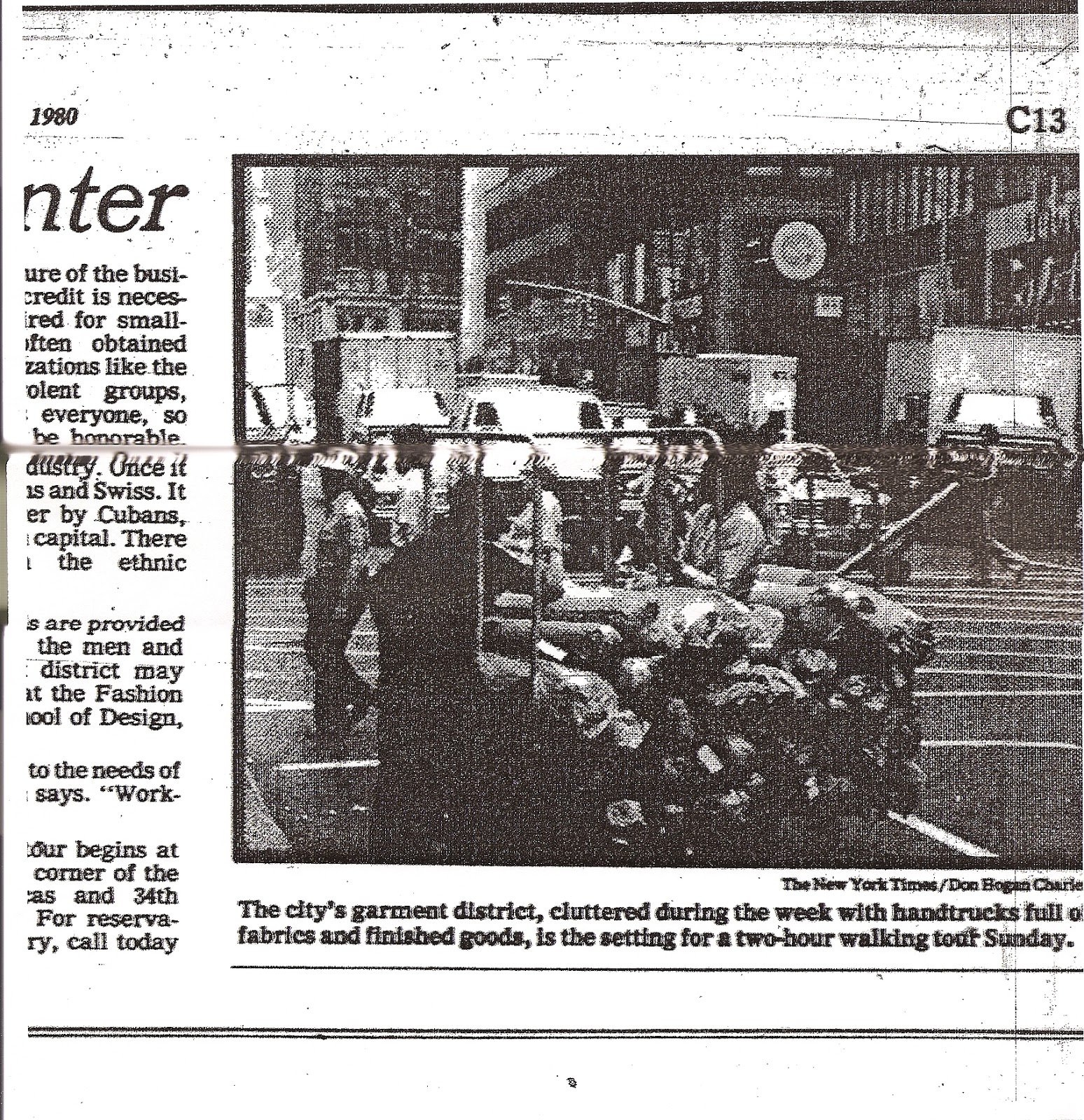
This picture comes from an article entitled "An Unhurried Walk in the Garment Center" by Jennifer Dunning. It is an interesting piece about a walking tour which was conducted in New York's garment district in 1980. Notice Dubrow's Cafeteria in the background - you can see part of the sign in the upper right corner.
Among other things, the article talks about how Dubrow's fit into the landscape of the garment district:
"The garment district is not only concentrated but also compartmentalized...'The district is more important as a display and distribution area than a major manufacturing area,' (James) Shenton saysm pointing up to a sooty Gothic-style emporium devoted largely to designer samples. 'Much of the manufacturing is done now in New Jersey, Pennsylvania, and North Carolina, though there is a revitalization of small-scale units of productions with the move back of Chinese to Chinatown and to Greeks to Astoria'...everything can be bought, it seems on Seventh Avenue, from "absolutely the best chocolate chip cookies in New York to holidays in Rumania.
On the corner of 38th Street alone, the fames Dubrow's Cafeteria and Lou Siegel's restaurant stand cheek by jowl with the Spanish Taverna. And each block has the most astonishing number of fast food restaurants, which suggests the enormous concentration of people here. A quarter of a million to 300,000 people pass through this area in the course of a normal workday."
(New York Times, Friday, July 11, 1980)
Tuesday, September 25, 2007
President Carter in front of Dubrow's

There's no article to accompany this image, but you can see that behind President Carter is part of the Dubrow's sign.
The caption for this article, which appeared on the front page of the Friday, October 31, 1980 edition of the New York Times, reads: "Carter ends New York Campaign. President Carter responding to union workers at rally in city's garment district."
Monday, September 24, 2007
A Cafeteria of Refinement
This is an ad from 1954. I didn't even realize Dubrow's advertised. Thanks to Marcia Bricker for this great find!

What's cool is now we also have a definitive answer as to when the King's Highway Dubrow's opened: 1939.

What's cool is now we also have a definitive answer as to when the King's Highway Dubrow's opened: 1939.
Sunday, September 23, 2007
Governor candidate stumps at Dubrow's
Well, it's been a long time since I updated this blog. I still have a couple New York Times articles left to post, but I finally made it to the Brookline Public Library, where I was able to track down a couple original copies on microfiche. The online New York Times archive wouldn't let me move the images in some of the articles, so I couldn't put them into a usable format to share here.

This one is of Hugh Carey, in front of the Manhattan Dubrow's. He was a Representative and a Democratic candidate for governor in 1974. The other photo is of another Democratic candidate (Howard J. Samuels) in Brooklyn. Excerpted from the accompanying article by Frank Lynn:
"Mr. Carey, for his garment center rally in front of Dubrow's Cafeteria at Seventh Avenue and 38th Street, had such leading Democrats as former governor Averell Harriman, former mayor Robert F. Wagner, and Mrs. Edith Lehman, widow of the Senator. Mr. Carey noted that Presidents Roosevelt, Truman, and Kennedy had spoken on the same site as candidates."
(New York Times, September 6, 1974)
But the title of the article is "Rivals for Governor Get Small Crowds" - apparently both candidates attracted very small limited numbers, and several people who did participate apparently did so negatively - they chastised Samuels for not allegedly not having paid his taxes. Hugh Carey won the Democratic candidacy and the election and went on to serve as governor from 1975 to 1982.
Anyone know more about Carey's statement about former presidents Roosevelt and Truman speaking in front of Dubrow's? I had only heard people recall seeing Kennedy in front of Dubrow's.

This one is of Hugh Carey, in front of the Manhattan Dubrow's. He was a Representative and a Democratic candidate for governor in 1974. The other photo is of another Democratic candidate (Howard J. Samuels) in Brooklyn. Excerpted from the accompanying article by Frank Lynn:
"Mr. Carey, for his garment center rally in front of Dubrow's Cafeteria at Seventh Avenue and 38th Street, had such leading Democrats as former governor Averell Harriman, former mayor Robert F. Wagner, and Mrs. Edith Lehman, widow of the Senator. Mr. Carey noted that Presidents Roosevelt, Truman, and Kennedy had spoken on the same site as candidates."
(New York Times, September 6, 1974)
But the title of the article is "Rivals for Governor Get Small Crowds" - apparently both candidates attracted very small limited numbers, and several people who did participate apparently did so negatively - they chastised Samuels for not allegedly not having paid his taxes. Hugh Carey won the Democratic candidacy and the election and went on to serve as governor from 1975 to 1982.
Anyone know more about Carey's statement about former presidents Roosevelt and Truman speaking in front of Dubrow's? I had only heard people recall seeing Kennedy in front of Dubrow's.
Friday, July 13, 2007
Recycling chairs
I know some Dubrow's items wound up on Ebay.
Apparently others were recycled into other restaurants. This comes from a 1988 article entitled "French bistros take all-American turn" by Joe Edwards.
"Like Restaurant Florent, the restaurant will be unpretentious and offer a good value, according to Morellet, who noted that dinner entrees would be priced from $7.75 to $13.50. But the decor is fancier--what Morellet called "high-style 1950s--a mix of contemporary and postmodern. Furniture includes the original cast aluminum chairs from the old Dubrow's Cafeteria, which closed several years ago."
(Nation's Restaurant News, Feb 8, 1988)
Apparently others were recycled into other restaurants. This comes from a 1988 article entitled "French bistros take all-American turn" by Joe Edwards.
"Like Restaurant Florent, the restaurant will be unpretentious and offer a good value, according to Morellet, who noted that dinner entrees would be priced from $7.75 to $13.50. But the decor is fancier--what Morellet called "high-style 1950s--a mix of contemporary and postmodern. Furniture includes the original cast aluminum chairs from the old Dubrow's Cafeteria, which closed several years ago."
(Nation's Restaurant News, Feb 8, 1988)
Tuesday, June 26, 2007
First jobs
Apparently, the children's author Bruce Farrington Coville worked at Dubrow's. According to this autobiography, his first job upon moving to New York City from Phoenix, NY was bussing tables at Dubrow's.
He doesn't say much more about what he thought about the job, but he has some interesting things to say about what it took to find a job in general in those days:
"I headed for New York City, figuring that since it was summer it would be off season for a tropical paradise and I would have no problem buying an airplane ticket to the islands. Wrong! As it turned out, I couldn't get a reservation for two weeks, though the airlines told me I could check on standby every day. (What I had really wanted to do was work my way down on a boat. But I got laughed at down at the docks, where they told me I'd have to join the union and unless I had a relative who was already a member, the waiting list was years long.)
Two strikes, and an important lesson for a writer: do your research! Having no intention of going home at this point, I was stranded in Manhattan. I went to the YMCA, where I got the cheapest room I could. In the lobby was a table where you could sign up for temporary work, and I took advantage of it, not wanting to draw down my little bankroll any more than necessary. I ended up washing dishes in a seafood restaurant, where I scrubbed away grease that seemed to have accumulated for years. They must have thought I did a good job because they gave me a fabulous meal in addition to my pay. The next night I got a job bussing tables at Dubrow's cafeteria in Brooklyn."
He doesn't say much more about what he thought about the job, but he has some interesting things to say about what it took to find a job in general in those days:
"I headed for New York City, figuring that since it was summer it would be off season for a tropical paradise and I would have no problem buying an airplane ticket to the islands. Wrong! As it turned out, I couldn't get a reservation for two weeks, though the airlines told me I could check on standby every day. (What I had really wanted to do was work my way down on a boat. But I got laughed at down at the docks, where they told me I'd have to join the union and unless I had a relative who was already a member, the waiting list was years long.)
Two strikes, and an important lesson for a writer: do your research! Having no intention of going home at this point, I was stranded in Manhattan. I went to the YMCA, where I got the cheapest room I could. In the lobby was a table where you could sign up for temporary work, and I took advantage of it, not wanting to draw down my little bankroll any more than necessary. I ended up washing dishes in a seafood restaurant, where I scrubbed away grease that seemed to have accumulated for years. They must have thought I did a good job because they gave me a fabulous meal in addition to my pay. The next night I got a job bussing tables at Dubrow's cafeteria in Brooklyn."
Subscribe to:
Posts (Atom)