Found this little blurb in New Yorker magazine (Feb 2, 2004):
THE BIG QUESTION
Borough Haul
The Nets, a top Zagat’s pick, maybe even Miranda—what does Brooklyn need next?
Nell Campbell, performer: “Paris—the city, not the hotel heiress. We’ve got a lot of French folk here; why not bring the whole goddamn city? Besides, we need some older architecture.”
Marty Markowitz, Brooklyn borough president: “Bring back Ebinger’s Bakery, Jahn’s Ice Cream Parlor, and Dubrow’s Cafeteria. If not, I’ll settle for Trader Joe’s and the Queen Mary II.”
Mike Albo, writer: “Maybe a flowery communal space with acoustic guitars and brambles and pot for everyone who doesn’t like sports. And thirteen more Starbucks?”
John Turturro, actor: “One thing we need no more of is power plants.”
Gavin Mcinnes, co-founder, Vice: “A half-decent jukebox in Williamsburg? All there is now is Janis Joplin, Morphine, and Santana.”
Wednesday, February 17, 2010


Tuesday, February 16, 2010
Pardon the makeover
I was noticing that in the old Blogger template the posts were getting really squished together. Besides, it's been 5 years since I started this blog, it was due for a makeover, right?
Let me know what you think. It looks so different I'm a little unsettled. Too weird? Should I keep it or try another one?
Let me know what you think. It looks so different I'm a little unsettled. Too weird? Should I keep it or try another one?
Wednesday, January 06, 2010
Miami Dubrow's listing

This is a listing from Info: This Week in Greater Miami. It calls itself "an official publication of the Miami Beach hotel association" and this listing was in the Vol. 1, Number 1 edition, dated November 18, 1950. The text reads:
"Dubrow's Lincoln Cafeteria 330 Lincoln Road 58-271 Miami Beach branch of the New York chain. Nationally famous for the most tempting hot sandwiches, cold plates, and steaks and chops. "
Photo of Miami Dubrow's

Monday, December 07, 2009
An email from a former Dubrow's employee
I love how people come out of the woodwork to share their Dubrow's connections. The fact that so many people are sitting at hoe Googling Dubrow's Cafeteria, 24 years after the last one closed, tells me how much it meant to people.
This one comes from a woman named Sonia Valentin:
"I was so surprised to Google Dubrow's Cafeteria and find this blog...wonderful...I was a 15 or 16 yr old Puerto Rican student in high school in the Bronx who got a part time job in the Manhattan cafeteria. I worked for four hours from 2-6 pm and was paid $1.50 per hour, and I worked Monday through Friday, and all day Saturday. I was in charge of the "freebies" station where customers got their juices, cole slaw, and applesauce. I was next to Ruth, Jewish, the cashier...and on the other side was Al Tabenkin, Jewish, another cashier...who became a dear friend for many, many years...i went to his 70th birthday party with my husband some time ago. I remember Joyce, African American, who bussed the tables with her daughter - whose name eludes me. I remember Bob, the manager, with the dirty blond hair and beautiful blue eyes - I had a crush on him. Another was Ben the hot meats and sandwich slicer - I was right next to him, and Angelo. This was the first time I ever tasted brisket of beef, and I recall there were some meats the employees were not supposed to eat but good old Ben, a Puerto Rican, always let me have a taste and made small sandwiches for me. I love eating matzo ball soup since this is where I had it for the first time. Angelo, another Puerto Rican, worked behind me and used to take orders for broiled fish, he was so kind to me always in those days when I first started there. Chen was chinese, and the manager of the food department and I remember when we went to the second or third floor to change into our clean, and crisp white uniforms with white shoes and white nylons, everyone was always cooking under his direction -- I was told he had many children. Felix, African American, was a counter man and was the fastest food server in the union and was always so informative about the foods, etc. I think the floor manager was Joe, Jewish....not sure of his name. I got this job via Maria, another Puerto Rican who went to school with me, had long blond hair, freckles, and lived in the same neighborhood as I did, and she worked the soda station.
I remember the day I came to work and found out that Irwin Dubrow killed himself. I believe it happened on a Saturday night and I found out when I went to work that Monday. It was a sad day, and people at work did not want to talk about it, and we were shocked that someone so vibrant, and young was gone. But I recall Irwin was always the quiet type, had wavy dark brown hair, and always said hello. "
Sonia would very much like to hear from other people who worked at Dubrow's from 1965-1968, when she worked there. Contact me via the blog and I can put you in touch with her.
Thursday, October 15, 2009
Photo of Dubrow's

This photo was submitted by Leslie Wong. It's on his Flickr page and his blog, and he has graciously allowed me to re-post it here. What a great shot and a great find! Not only a great shot of fabulous mural at the Manhattan location, but of some customers eating there at the time.
Sunday, September 27, 2009
More reader feedback (Glen)
Another reader, Glen, writes in enthusiastically to say how much he loved Dubrow's:
"Hi! I think it's great that you have your website about Dubrow's!
I used to eat there often in 1982. I'm lucky that I got to experience the place; I just made it, too. Little did I know that it would close three years later.
WHY did it close? The place was ALWAYS packed. At least it was in 1982. That's when I commuted into Manhattan every day to work.
The food at Dubrow's was GREAT! I never went to a place where they absolutely HEAPED the food on your plate, and it was DAMN GOOD FOOD, too, and the prices were reasonable. It was one of the best values in town.
I can't tell you how much Dubrow's and other places like the Horn & Hardart automats, and other cafeterias.
Manhattan has become an exclusive playground for the rich yuppies. You can't even LIVE in Manhattan anymore unless you're a millionaire. I have friends that both grew up on York Avenue, where they lived in tenements. They were VERY poor. NOW, those "TENEMENTS" would be unaffordable. They both live in Queens, which is where I live and where I grew up. They LOVED living on York Avenue, but, as they say, you can't go home again. It really is true.
It sickens me how New York City is losing its soul. You can't even get an egg cream in New York City anymore. I mean, what's more New York City than an EGG CREAM???????? What a damn shame.
There's nowhere in Manhattan left to eat. What's the choice? There's McDonald's, and there's fancy restaurants, and there's NOTHING IN BETWEEN now in Manhattan. I guess this is just another sign of the shrinking of the middle-class in America. Pretty soon, America will be just like all those other countries: The very rich and the very poor, and that's all! Nothing in between.
As huge chain restaurants and fast food restaurants take over both the city and our nation, as well, we are losing our national identity. New Yorkers, whether they be from Brooklyn, Manhattan, Queens, or the Bronx (I never even THINK about Staten Island because I've only driven through there!!!!) are losing their identity. New York City, just like the rest of the nation, is becoming homogenized and watered down, whether it be accents, mom and pop stores, and other things. If you ask in Queens, where I live, if there's a luncheonette nearby, you'd be looked at like you just came from Mars. They don't KNOW what a luncheonette is, they don't KNOW what an egg cream is, it's unbelievable.
Dubrow's, The Garment District, egg creams, luncheonettes, cafeterias; it's all leaving or has already left the culture of this once-great city.
It's sad to see this happen to the city where I grew up."
What I told Glen in an email is my best understanding of why Dubrow's closed: The price of real estate in Manhattan skyrocketed and made it no longer possible to make enough money off of Dubrow's to keep it open. If people have been to that stretch of Seventh Avenue in midtown Manhattan, they wouldn't be surprised by the theory, and it seems to be generally supported by the articles I have found about the closing.
What is less clear to me is why the locations in Brooklyn or Miami closed, although I would hazard a guess to say it was also about money. It usually is, and especially when a place was so well loved you can't imagine any reason to close it.
Sunday, August 23, 2009
Ask and you shall receive!

Marcia Bricker Halperin has unearthed this photo of Nissa, the woman about whom reader Julia asked in my last post. Marcia confirms that Nissa was in fact a busser and says this photo was taken in about 1977. Perhaps some day Marcia will find photos of Julia's grandfather as well.
Monday, August 10, 2009
Reader seeks information
I received an email from Julia, who sends this letter:
Good morning, Eve.
I hope my email finds you well. I stumbled across your blog when doing a search on Dubrow's Cafeteria for my grandfather. He worked for your family's Garment District location for decades and really held the management, owner, and staff in familial regard. When it closed in the mid-eighties, my grandfather regretfully lost contact with one particular employee who treated him like a dad. Her name was possibly Nissa Morales Orivera or some derivative of that. Being 84 years old, my grandfather's memory is understandably not 100%. His name is Danny Solomos. He was loved by many. I am hoping that amongst the archived information you have gathered about your family's business, you may be able to unearth some record of this woman or even my grandfather. He wants to reconnect with her before "he goes" as he puts it.
Any help you could offer would be stellar. Some other helpful details he remembers are that she would now be between 55-65 years old. Her mother Rosa also worked for that Dubrow's and they both hailed from the Morris Park area of the Bronx.
Thanks so much!
Anyone recall Nissa or Danny from Dubrow's in Manhattan? In a subsequent email, Julia went on to say that she thinks Nissa worked as a cashier, while her grandfather worked as a baker and possibly a cook for about 25 years.
Sunday, July 19, 2009
Matchbooks from Dubrow's


Purchased these off of eBay from two different sellers. The more faded one lists the Eastern Parkway (Brooklyn) and Lincoln Road (Miami) locations on them, and was dated as a 1940's matchbook. The third image is the inside of the more faded matchbook cover - war bonds! Proof that it it is from the 1940's. I love it. I especially love the use of "U'r" which allows it to spell out "DUBROW." The less faded one did not come with a date or have anything printed on the inside of the cover.
Sunday, July 12, 2009
A letter from the son of Irwin's best friend
With permission, I am reprinting the email I received from the son of Irwin Dubrow's best friend. I think you can hear the tragedy of the family in his words, and he asked that his name not be reprinted in the blog.
"I am the son of Ira R Legon. My father was Irwin's best friend. The two grew up in a Jewish neighborhood in Brooklyn in the 1940's. He is my Uncle Irwin, as I have known him my entire early years, plus I know his wife Annie, adopted daughter Joanne, and of course Barbara.
I remember the day he commited suicide at the 7th avanue operation. It was a very dark day for the Legon family indeed. My Father said to me that the pistol had "slipped" thus putting the end to his life. I have many stories about your great uncle, however they will be for you and your family, and not your blog space. In 1968 your great uncle had a powder blue Jaguar XKE, he let me drive the car (in his lap). I have always felt that this was the most beautiful car manufactured. He lived in Upper Saddle River, NJ. Annie was there (we still use her marinade for chicken), as was Joanne, and Barbara was a newborn.
Twenty years ago we had Annie and Barabra to our home for Christmas dinner. (Not bad for some Jews). I remember Barbara crying as she realized the significance of the situation.
Now for you...We have many pictures of my Uncle Irwin, along with my father. They date back all the way to there Camp Winadou days in the early 1940's. The symbiotic analogy might help you as that camp was in Massachussetts. My family will be more than happy to send you all the pictures that we have, with the regards to your deceased family members. Uncle Irwin would want you to have these photographs.
We have reconsidered, and will allow you to post our message as a blog. My request is that you do not use my name, however everything else is for your choosing.
Last night my mother and I went through my parents' wedding album and found many pictures with your great uncle. We have an exorbanate amount of boxes to go through to find all we can about my Uncle Irwin. (I wish my Father was still living to give you the "skinny" on Irwin). I know for a fact that none of the photography includes any Dubrow's deli or restaurant operations. These are family photos and are cherished deeply. We will make copies once we compile all the pictures we have.
I remember all the operations, NY (7th ave), Alfie's (Irwin's restaurant), and of course the Miami operation, (to) which my grandparents always took the grandchildren.
I still can describe Alfie's, sitting at the 7th ave shop, and of course Miami. Did you know that your great uncle was also a Mason? I have the picture right in front."
I did *NOT* know George was a Mason. Fascinating. I love that I found what seems may have been the exact type of car George Dubrow owned (and perhaps died in) via the internet. I am looking forward to seeing pictures my new friend unearths, and have also discussed scheduling an interview with him this fall.
Finding more Dubrow relatives
Have I told you the story of how I discovered a cousin lived a mile away from me, but we never knew the other existed?
That is how the Dubrow family seems to work. There are so many Dubrow family members wandering this country - perhaps the world - and little by little they are finding their way to each other, often by way of this blog.
Alice Gruber Phinzy is the cousin I discovered this way. She is, it turns out, the granddaughter of Ruth Gruber, who is my grandmother's younger sister. Ruthie and Sylvia are the youngest two children of Benjamin and Rose Dubrow, and the only two born in this country. In a stranger coincidence still, Alice knows my hairdresser - not only that, she nannies for her son! The world is a small place.
I recently got an email from Richard Hume, who informed me that he is the grandson of Jacob Solowey, who is the younger brother of "Rasel Soloway Dubrow" - who I know as Rose Dubrow. The woman who married my great grandfather, who started Dubrow's Cafeteria. As he points out, this makes him my second cousin, once removed, but as his family did not see the Dubrow family much, I never even realized Rose HAD siblings. It never occurred to me.
Finally, I also received an email from a man who reports that Irwin Dubrow (manager of Dubrow's, son of George Dubrow, and grandson of Benjamin) was his father's best friend, and they were close family friends until Irwin's death. I am currently negotiating about whether I can share any of their family's stories here, but suffice to say there is a lot more to be learned about my family's history...
As I have said to many people, and probably here on the blog before, the exciting part about this process is watching the connections unfold. I am reading The People of the Book by Geraldine Brooks, which is all about the unfolding of history, layer after layer. That's what this is all about.
Sunday, May 17, 2009
Finding old photos and long lost relatives

Marcia Bricker Halperin found this photo in a 1971 high school yearbook. The photographer was uncredited. What a find! Anyone out there attend James Madison High School in Brooklyn, NY?
Meanwhile, Marcia has also received great news - she has gotten a first influx of funding from the Brooklyn Arts Council Community Arts Regrant Program for a documentary about New York cafeterias. She'll cover Dubrow's, and utilize things from this blog, as well as some of the other New York cafeterias that people have recalled fondly over the years I've been running this blog.
Finally, I discovered a long lost relative: Barbara Dubrow Faerman. She's the daughter of Irwin Dubrow, former manager of Dubrow's until his untimely suicide. She writes: "I did go to the cafeteria a few times and some of the old time staff took extra special care of me and showed me around the inner workings of the cafeteria. I remember seeing portraits of Benjamin, George and my father on the wall...I believe that my aunt Helene got some of them when the cafeteria closed. I have a cross stich that was made for me by one of the staff when I was born."
I'm hoping she can find that cross-stitch made by a Dubrow's staff member! I have been in touch with Helene but have not in New York, where she might have some of the memorabilia to which Barbara referred.
Wednesday, February 04, 2009
"Dubrow's was like an indoor sidewalk cafe"
Found this reference to Dubrow's in the historical novel Subway Music by Reynold Joseph Paul Junker.
"Now I paused and looked left and right again.
'We used to go but I wanted to step around here to the left a minute. I wanted to see something else first. I wanted to see if Dubrow's is still here.'
I turned left. She followed. We walked the short distance to where Dubrow's used to be on the corner of King's Highway.
Dubrow's was gone from the corner of King's Highway. Dubrow's had been a single story cafeteria with floor to ceiling windows looking out over the sidewalk. Dubrow's was like an indoor sidewalk cafe. Families when to Dubrow's to enjoy "home cooking." We went to Dubrow's to stare and make creative faces and simulated retching noises through the windows at families enjoying their "home cooking."
'There used to be a Dubrow's Cafeteria here,' I said.'The firemen from the firehouse on 14th street used to send us there for takeout food - mostly veal cutlet sandwiches. There was no fast food in those days.'"
Sunday, January 18, 2009
Still here
Man, it's been a long time since I updated this blog. Sorry about that. It's been a pretty difficult couple months for me personally.
I've received a couple comments from readers I thought I'd share:
Rick Festa writes: "I am Leo Martin's grandson and my memories of Dubrow's are so vivid...The stuffed roasted chicken really stands out in my mind, and have never found a stuffing like that since. I spent many hours there with my Grandfather as a young boy, and i can still remember that special smell of the place. I still remember the faces of the cooks and the cashiers and that cool change returner attached to the side of the register..."
Deborah Berman writes to ask about the recipe for "the most memorable bran muffins in the world." As always, I do not have any recipes - I wish I did! So far I haven't found anyone else who does, either.
Dan Russell writes to ask about a Dubrow's in Bensonhurst and another "famous one on 86th street" - I am not sure both of these he is recalling are Dubrow's, but the latter is probably the one on Eastern Parkway. Anyone remember a Dubrow's in Bensonhurst?
Finally, I also found an excerpt in The World on a Plate by Joel Denker about Dubrow's:
"Cafes also became center of Jewish cooking and companionship. The Garden cafeteria, next door to the Jewish Forward, was a gathering place for reporters, actors, intellectuals, and ethnics who worked in the neighborhood. Like an eastern Europe cafe, it buzzed with conversation and animated debate. Places like the Garden encouraged a breed of ethnic socializers that Isaac Singer, who was one of them, dubbed cafeterianiks.
The Garden, which opened in 1931, was organized like a cafeteria. Customers decided on their order, and the counterman punched the appropriate code on their ticket. There were the classic dairy choices - blintzes, varnishkes, soups. The display case revealed a tantalizing plates of smoked whitefish, herring and apple and other salads, cheese, and coffee cakes. Many diners were content with a piece of cake and tea or a bowl of chopped vegetables and fruit mixed with sour cream.
As the Lower East Side rag trade withered away, Jewish cafeterias and luncheonettes sprang up in the midtown Garment Center. Dubrow's, one of the most famous cafeterias, served up pirogen, gefilte fish, and roast chicken to cutters, jobbers, and pressmen. Irving Moskowitz, a Dubrow's Cafeteria customer for over thirty years, remembered it as a warm gathering place: 'It was more than just a place to eat. It was a meeting place. A place. You didn't get to know them [other customers]. But they were people, and you sort of knew them.'"
Monday, July 28, 2008
Interview with Helene D. Grossman (Part 2)
1. What was your impression of running Dubrow's, for Irwin and for George? Did it seem to bring them joy? Did it seem stressful? Which store(s) did they run and for how long?
"Irwin stepped up to the plate to run Seventh Avenue, and our family’s interests in Eastern Parkway and Florida, after George’s death. He had worked there prior to that but was not at all set on committing to the restaurant business as a career, despite having majored in Hotel and Restaurant Administration at Cornell. I believe his reluctance was due to a number of factors typical of Jewish sons in the 1950’s, including wanting to apply newer management models and other knowledge that they has acquired in college to their family business with their dads not being convinced this was needed and in Irwin’s case, issues relating to the fact that George was somewhat of a legend in the field.
Nonetheless he ran Seventh Avenue, and together with Irving Kaplan acquired Toby’s Cafeterias (3, I think) in Miami in the 1960's, which Irving ran. [Note: Toby’s were in non-Jewish neighborhoods and served Southern style food, with favorites being chicken dumplings and black eye peas.]
In the mid 1960s Irwin opened Dubrow’s Takeout Shop (exact name?), on Third Avenue and 74th Street in Manhattan, which Leonard [Irwin's brother] ran. It offered many packaged, prepared foods for which Dubrows was known but it was just a bit ahead of its time. That area and all around NYC is now filled with that type of prepared food take out shops. Irwin subsequently opened, ran and expanded Alfie's restaurant at that location. Irwin came to enjoy the business more as time went on but differently than George. It was not his whole life to nearly the same extent as it was George’s. Irwin ran the Seventh Avenue cafeteria and Alfies until his death in 1970.
Irving Kaplan and Paul Tobin purchased the Seventh Avenue cafeteria in 1971(?), with Paul running the day to day operation, and Irving’s oversight and active involvement in all management decisions and regular on-site participation about every 6-8 weeks. The property was purchased by the bank adjacent to the cafeteria, which planned to expand/build a garage, and the cafeteria closed. The expansion/garage never went forward and today, an OTB parlor is on this site!"
Tuesday, July 22, 2008
Interview with Helene D. Grossman (Part 1)
I caught up with my cousin Helene a couple weeks ago, and she graciously took the time to answer some questions about Dubrow's for me, in a somewhat formal written interview. I'll be posting her responses over a series of posts.
Just for reference: Helene is the daughter of George Dubrow, sister of Irwin Dubrow, and granddaughter of Benjamin Dubrow, all of whom managed Dubrow's at different times.
1. What was your impression of running Dubrow's, for Irwin and for George? Did it seem to bring them joy? Did it seem stressful? Which store(s) did they run and for how long?
"For George, Dubrow’s was his life. He loved every aspect of running the “stores”. George had an incredible joie de vivre, was very much a people person and enjoyed interacting with his employees at all levels as well as with his customers. He shared their happinesses, trials and tribulations and lent his ear and advice and often, financial support. I still have a ring that a customer gave him in appreciation of his kindnesses. His measure of quality control was a random tablespoon of prepared foods, especially his favorites, before they left the kitchen…he was a bit rotund and we all thought this was his best excuse not to stick to a diet! He was not a morning person, and usually went to work at around noon, staying until midnight, the exception being most Friday nights, when he came home for dinner, under duress from my mother, usually returning to work after that. George’s personal and business philosophy was that you are only as good as tomorrow, not yesterday. I suspect that fed his drive for success. There certainly were stressful situations at times, particularly dealing with the unions….I think there were 6 or 7. "
She goes on to provide some more detail about George's history at Dubrow's, which I found very helpful:
"George opened and initially ran all of the cafeterias which included Dubrows Eastern Parkway (Utica Avenue), Dubrows Kings Highway ( 16th St), Dubrow's Lincoln Road (Miami Beach), Dubrow's Seventh Avenue (Manhattan) and Dubson's Restaurant (on Utica Avenue around the corner from Dubrows Eastern Parkway Cafeteria). "
Much more to come - about Irwin, about Max Tobin, and more! Stay tuned.
Monday, June 30, 2008
Reader feedback (Danny, GK)
Lately, I've been hearing from a lot of people about the various Dubrow's foods they miss. It's all about the food, which makes sense, since first and foremost, Dubrow's was a restaurant. But if there's one thing we've learned in the past three and a half years I've been keeping this blog, it's that it's so much more.
Danny Karron writes:
"Our (my brother Abe and I) dad Edward Karron was (best?) friends with Irwin Dubrow. My brother and I were ruminating if we could id Irwin from a bunch of wedding pictures Abe had scanned. I found you from the Dubrows Cafeteria wiki entry which pointed to your web site. I'm getting hungry just thinking about the place. I think I still remember the stuffed cabbage or the Blintzes. I'm getting indigestion thinking of them at the same time."
GK commented on an old post:
"My favorite was the cheese blintzes with sour cream. I have never had better. My sister would always get the cottage cheese and sour cream with vegetables. I also loved making lemon soda with the seltzer water dispenser and free lemons from the fish counter."
Friday, June 27, 2008
Dubrow's Photo

This is another photo taken by the always amazing Marcia Bricker Halperin. It's on display in what looks like a fantastic exhibit at the Brooklyn Museum.
Update: In the past three or four days, I have spoken to Helene and Leonard Dubrow, children of George Dubrow and siblings of Irwin Dubrow. I have also heard from my cousin Geoffrey Green, on the "other" side of the family...all of whom wanted to let me know that this exhibit and in particular, this photo, was featured in the New York Times this week. I am delighted that it is getting such good coverage and attention - and I am thrilled that of all the photos Marcia took for the exhibit, the Dubrow's photo was selected for the article. What wonderful attention it has brought to the memory of our beloved Dubrow's.
Wednesday, June 11, 2008
More reader feedback (Sue)
Received another email a couple days ago:
"My father who is 84 was born and raised in Brooklyn. He often reminisces fondly about Dubrow's and the shrimp salad he ate there with his friends. Evidently your great grandfather's restaurant plays a large part in the happy memories of many people, something which I am sure you are proud. I was wondering if you had access to the recipe for shrimp salad served there. I would like to make it for Father's Day for my Dad. He thinks it had mayo, vinegar, cream in the dressing. Thanks so much!!"
Anyone recall the Dubrow's shrimp salad recipe?
I would love to track down or hear from some of the cooks at Dubrow's, and put together a collection of recipes for popular dishes. Over the years, there have been a number of requests for recipes.
Sunday, May 25, 2008
More reader feedback (MacKenzie)
More feedback from a reader! I love hearing from people.
MacKenzie Allen writes:
"Hi, there...I found my way to your website while looking for old photos of Dubrow's. I was telling my wife and friends about it. I grew up in Brooklyn (1940s--50s) and lived at Avenue "O" and East 16th St...a few blocks up from Dubrow's. When we were kids at Cunningham Jr. H.S. we used to go there on lunch hour. A real treat was to "take out" an order of french fries in a brown paper bag. We'd put ketchup in the bag and shake it around to distribute it. Messy, but delicious. It was always a treat to go to Dubrow's...great memories of a far better time."
Friday, April 25, 2008
Questions from readers
Jeff writes with recollections and a question about the Miami Beach Dubrow's Cafeteria. I know very little about this, but I thought I'd see if anyone else did. I'm pretty sure I remember going to Dubrow's on Lincoln Road, but honestly, I was so young (I was 12 in 1985 when the last Dubrow's Cafeteria closed for good) I could be mixing up Manhattan and Miami, since I went to both places at different times in my childhood.
Jeff writes:
"I found your blog site while trying to research the Dubrow's located on Lincoln Road in the 1950's through sometime in 1963 (?).
I'd moved to Miami Beach as a youngter when my family relocated from Brooklyn around October of 1963, and at that time the Dubrow's on Lincoln Road was closed and had a "Bankrupt" sign hanging on the inside of the doors. A couple of years later, the location reopened as "New Dubrow's, Inc."
Did your family reopen it, or was it run independent of them?
Also, a dear, departed friend of mine was in the sign business down here since 1948. He did work for the Lincoln Road Cafeteria - the original name of where Dubrow's ws located. Did the family purchase that location, or originally run it as the Lincoln Road Cafeteria?"
Also, Marcia has a question about the picture of Kennedy in front of Dubrow's:
"I believe this photo of Kennedy was taken on the 16th Street side in front of Craig's Bake Shops which was across the street from Dubrows. Maybe they had the rally on the side street or brought Kennedy into Dubrow's through the kitchen entrance which was there. Can Ms. Cohen confirm this? My mom says she remembers my Dad went to see Kennedy there that night. "
Thursday, April 10, 2008
Kennedy with Max Tobin

Sanda Bragman Cohen, the woman who mailed me the photos of Kennedy at the King's Highway Dubrow's, had this to say about the photos:
"They were taken by a photographer hired by Max Tobin who owned Dubrow's on Kings Highway. He is the man standing behind President Kennedy. His wife was Minnie Dubrow Tobin who was Sylvia Kaplan's sister. Minnie Tobin died in 1957. My mother, Mary Bragman, is the only woman in the picture. She married Max Tobin in 1968 when my father had been dead for four years. My father is the man that can only be partially seen standing behind Max Tobin. The photography studio was named Renard and it was located in Brooklyn. As far as I know the pictures were not copyrighted by anyone. They belonged to Max Tobin, because he paid for them. They were given to me by my mother just before she died. Until then they were in her home. The pictures were taken in October, 1960 when Kennedy was campaigning. Many politicians made a stop at Dubrows because it was the most popular place in that neighborhood (Flatbush), but I do not have any other pictures. The two men sitting next to Kennedy were Brooklyn politicians, and I used to know their names, but I have forgotten. Standing behind my mother, kind of in the shadows, is Carmine DeSapio (he is the man with the sunglasses) who was a powerful politician at the time. I remember that Kennedy wanted a steak and salad for dinner, which was provided for him. It was not the usual Dubrows food. I also remember that my mother was answering the special phones that had been connected for Kennedy and in that picture she is handing him a message from Robert Kennedy. My parents wanted me to have my picture taken with Kennedy, but I was fifteen and had a pimple, so I refused. Needless to stay I lived to regret that decision. However, I did wear a campaign button that said, "If I were 21 I would vote for Kennedy." I would have too!"
Tuesday, April 08, 2008
JFK campaigning at Dubrow's

Several other readers have talked about their recollections of JFK campaigning at the King's Highway Dubrow's. Reader Sanda Cohen has submitted a couple fabulous photos which commemorates this event. This is the first of those photos.
Wednesday, February 13, 2008
More reader feedback (Darryl)
I've been getting a bunch of emails from readers, which is just fabulous. I can follow the stats as to where people are when they're reading, but I have to hear from you to know WHO you are, and what Dubrow's means to you.
Darryl writes:
"My friend Marty and I would spend many a Friday night at Dubrow's on
Kings Highway. My particular favorite was the vegetable cream cheese
on a bagel. The counterman would dunk the bagel into a tray full of
chopped vegetables that would then stick to the cream cheese. One
night we met an elderly woman named Libby Siegel who had the peculiar
ability to spell any word backwards. We tried to trick her with extra
long words but she never missed.
When I was younger I did go the the Dubrow's on Eastern Parkway and
Utica. Unless I am mistaken, I drove by that corner about ten years
ago and saw a Dubrow's sign still hanging on the Utica Avenue side of
the restaurant. It was an art deco style possibly made of glass . It
was surrounded by all the billboards of the newer stores and was
barely viewable. I wonder if it is possibly still there.
If there are any artifacts around from the restaurant I would
certainly love to be able to get one. I did have one of those white
sailor type hats the countermen wore. The picture of the tray brought
back some memories.
Thank you. My life in Brooklyn during the fifties was a special time
for me and Dubrows was a nice part of it."
Friday, February 01, 2008
More reader feedback (Marty)
Received another email recently, this one from Marty:
Hi Eve,
I was taking a little trip down memory lane and decided
to google Dubrow's. Your great grandfather had a
great cafeteria. I frequented the Dubrow's on Kings
Highway in Brooklyn for many years with my friends.
We would meet late at night for something to eat after
we took home our girlfriends. Sometimes we would just
go there late on a Friday night if we had nothing else
to do. We were in our twenties, while most of the
people there were senior citizens. The seniors loved
it there. It was a place for them to go if they just
wanted to talk to someone. We would hang out and talk
for an hour or two before heading home. Dubrows had
the best rice pudding! I moved out of Brooklyn many
years ago, but still have fond memories of Dubrow's
After I got married, I found out that my wife's late
uncle was a counter man at Dubrow's for many years.
Thanks for the website. It brought back nice
memories.
Marty
Thank you, Marty, for reading and for sharing your memories! I love hearing from people.
Wednesday, January 30, 2008
A request from a reader (Joe)
I received an email from a reader. Joe asks about another cafeteria very close to Dubrow's:
Yes, it was called the "Famous Cafeteria" and it was very similar to Dubrows, but it was located in the Bensonhurst section of Brooklyn on 86th St. and now I see that it was located directly across from Dubrows...Maybe you can post a request in your blog?
Here's a quote from another Brooklyn Blog....
"And diagonally across the intersection from Dubrow's was the Famous, a dairy restaurant where delicious dishes like perrogies and sour cream were served. What would today's nutritionists say about that. Better yet, what would they say about "gribbinus" (transliteration), a delicacy made from fried chicken fat. "
http://www.geocities.com/buddychai2/Brooklyn/RememberWhen2.html
Anyone have any more information about Famous Cafeteria to help Joe out?
Amoeba-like architecture
Found this in another New York Times article:
"It is no accident that it took more than a generation for Art Deco architecture to be appreciated, and similarly, this is why such 50's extravaganzas as the Fontainebleau Hotel in Miami Beach seem far less disturbing now than when they were new. It is not perverse taste, it is that they have become a part of the landscape we expect to see, and thus derive a curious kind of comfort from. So, too, with such an oddity as the interior of Dubrow's Cafeteria on Seventh Avenue in the garment district, which has those swirling, amoebalike shapes characteristic of 50's interiors. I walked past it the other day and was shocked to realize how that room, long an object of derision, is beginning to take on a certain appeal."
(Paul Goldberger, New York Times, July 30, 1981)
It's interesting to go back and see how differently things were perceived at different times. I don't think people would think the architecture at the Dubrow's in Manhattan is particularly unusual today. But clearly back then, at least this guy thought it was odd. And of course this is what he's saying - but now, over twenty years later, I think this just proves his point even more.
Monday, December 17, 2007
"Aspired to opulent excellence"
"When winter came, the candy stores and cafeterias replaced parks as forums to debate politics and art. People gathered at candy stores "to discuss politics and unionism." Local kids "made pocket change by hanging out at Leboff's candy store [one of five on Charlotte street], and calling people to the phone." Hoffman's Cafeterias on Pitkin, Flatbush, and Brighton Beach Avenues also entered the radical element. (Irving) Howe recalled that "in the winter, when the Bronx is gray and icy, there were cafeterias in which the older comrades, those who had jobs or were on WPA, bought coffee while the rest of us filled the chairs." Other cafeterias, like Dubrow's or Garfield's in Brooklyn, aspired to opulent elegance. Garfield's dubbed itself "a cafeteria of refinement." Located on the corner of Church and Flatbush Avenues, diagonally across from the Reformed Dutch Protestant Church, Garfield's boasted an interior decorated with mosaics done in Art Moderne style. Dubrow's, a dairy cafeteria, also served as a neighborhood meeting spot with its attractive location by the elevated station, on a shopping street like King's Highway."
(At Home In America: Second Generation New York Jews, by Deborah Dash Moore, 1981)
Now, a few questions about this. First, could Garfield's and Dubrow's had the same tagline to describe themselves? Because this post indicates that Dubrow's advertised itself as being "a cafeteria of refinement" - yet here it says Garfield's used that line.
Furthermore, this post indicates that the Dubrow's on King's Highway had a very modern decor, using mosaic. This is how the author (who cites a number of different sources for this particular passage, including the reputable Irving Howe) describes Garfield's. Could Garfield's and Dubrow's BOTH have had mosaic in their decor? Or is she mixing up Garfield's with Dubrow's?
Friday, December 14, 2007
Where Dubrow's Used To Be

I visited the site of the Manhattan Dubrow's this fall when I was in New York City. When I came home, I found this article which referenced when the Offtrack Betting place opened up where it used to be.
"With a little luck, a new offtrack betting branch will open this fall in mid-Manhattan. But before the first $2 bet is placed, the Offtrack Betting Corporation will have spent $739,000 in rent for a branch that took almost two years to open.
Present and former officials of the agency clash over who is responsible for the delays in opening the branch at Seventh Avenue and 38th Street, on the site of the old Dubrow's cafeteria. But the officials, from two OTB administrations involved in the project, agree on one point: the abnormal costs will reduce the OTB's overall profits this year and the revenues it can give the city."
(New York Times, April 9, 1992)
This is a cool sculpture currently found in the area which pays homage to the Jewish garment workers of yore.

Thursday, November 15, 2007
Dubrow's in Miami
I have found very few references to the Dubrow's Cafeteria in Miami, although I remember it vaguely, from my childhood. It was right on Lincoln Road, which is a stone's throw from where my grandparents lived for most of my childhood. I spent much of my childhood visiting from Texas, staying with my grandparents, and walking from their apartment all the way down Lincoln Road till I got to the beach. Back then, it was pretty dead - now it's become a hotspot with clubs and trendy restaurants.
I found this in the book Catskill Culture: A Mountain Rat's Memories of the Great Jewish Resort Area by Phil Brown:
"From all their years in the Catskills, these Mountain Rats were the insiders who really knew the scene. People had their favorite local bars and restaurants for hanging out after a day of hard work, where conversations typically turned to who was working where this year. The chatting and hanging out continued in Florida in the winter, where they met friends at Dubrow's Cafeteria on Miami Beach in Lincoln Roadand reminsced about last summer in the mountains. That magic pulled them back the next summer, and the grew old and infirm, along with the Catskills themselves. As the region declined in the 1970's, the Mountain Rats competed for fewer and fewer jobs, and many had trouble setting up permanent roots. Cubans displaced them in the Miami Beach hotels."
Wednesday, November 14, 2007
The meaning of a cafeteria
I've found a couple interesting books at the library that mention Dubrow's, in the context of understanding the history and sociology of Brooklyn, Manhattan, and Miami Beach. I'll be posting some of my findings over the coming weeks.
These quotes both come from The Jews of Brooklyn by Ilana Abramovitch and Sean Galvin:
"Brooklyn boosters are prone to promote cohesion through nostalgic reminiscences, embracing detailed discussions of famous locales like Coney Island, Prospect Park, and the Brooklyn Bridge. Cherished neighborhood spots like DuBrow's Cafeteria, Schechter's candy store, or Erasmus Hall High School provide content for more specialized games of trivial pursuit."
Later in the book, there's a wonderful description of just why places like Dubrow's were so beloved in their communities:
"By far the most popular eateries were the kosher delicatessens, a Jewish-American invention. There was a deli on every block because, said the manager of Grabstein's, 'a hot dog sandwich and a pastrami sandwich and a knish was a way of life.' With their 'salami sanwiches and pickles wrapped in coarse white paper,' the delis were 'the culinary hearts, if not the heartburn, of working-class and immigrant Jewish neighborhoods.'"
(The Jews of Brooklyn, Ilana Abramovitch & Sean Galvin, 2002)
Friday, October 26, 2007
Community evolved
I found this to be an interesting reflection on the meaning of Dubrow's. This is part of a longer piece about Square One, a restaurant in San Francisco, CA. The owner, Joyce Goldstein, also mentions Dubrow's Cafeteria in the introduction of her cookbook Cucina Ebraica: Flavors of the Italian Jewish Kitchen, as she is talking about the influences on her cooking.
"The shaping of Square One began in Joyce Goldstein's childhood, when the family lived in an apartment building in a lower-middle-class neighborhood in Brooklyn. Community evolved and was maintained in the local delicatessen, in Dubrow's Cafeteria, in Roseman's grocery, and in Mr. Silverstein's candy store. On the streets you saw people, she recalls, but in those places you got to know them. "
(Celebrating the Third Place: Inspiring Stories About the "Great Good Places" at the Heart of Our Communities, edited by Ray Oldenburg, 2001)
Thursday, October 25, 2007
Every customer was a half hour
I found a couple interesting books at the library, and I'll be posting my finds here over the next few weeks. One of them is a collection of oral history of Brooklyn from the mid-twentieth century. Here's three quotes I found about Dubrow's:
DAN LURIE: "On Saturdays, I'd put on a nice shirt and stroll up and down Pitkin Avenue. It was the Fifth Avenue of Brooklyn, with stores like Abe Stark's men's clothing, Fisher Brothers' ladies coats and suits, Dubrow's or Diamond and Coopersberg furniture."
KARL BERNSTEIN: "'You're all a bunch of Kings Highway bourgeoisie,' Miss Deborah Tannenbaum would tell us. 'You hang around in front of Dubrow's getting vicarious thrills out of life.' I didn't understand what she was talking about. Miss Tannenbaum was only about five feet tall, but she was dynamite. She taught only the best English classes at Madison, on such a high level. We read Portrait of an Artist, and I became so scared to death of going to hell, I hardly ever opened my mouth, I was so afraid of that woman. But I sat down and took the English Regents and got a 96."
MARTY ADLER: "A few blocks before Ocean Avenue, just past the Brighton el, was Dubrow's Cafeteria. That's where you ended up on a Friday night. If you were lucky enough to have a car, you kept it down to three guys so there's be room in case you picked up some girls. The Madison and Midwood cheerleaders were there, and they were the prettiest. You'd take them to a movie, or someone's party. Around midnight, you would drop by Dubrow's again to see if any of the other guys were around. You'd tell stories about what happened thatn night and then hook up for a ball game the next day."
(It Happened in Brooklyn: An oral history of growing up in the borough in the 1940's, '50's, and '60's by Myrna Katz Frommer and Harvey Frommer, 1993)
Thursday, October 11, 2007
Chronology
I went to Manhattan this past weekend, and had a wonderful visit. I went to Katz's and met Marcia Bricker, who has contributed many amazing photographs of Dubrow's. We are both excited about the possibility of putting together a documentary of Dubrow's. She recently had her first film selected for the Coney Island Film Festival - very exciting!
She requested that I try and recap the chronology and also the genealogy of Dubrow's Cafeteria and the Dubrow's family, so that's what I'm going to do. Here's what I've got so far:
1907: Simon and Rivka Soloway, parents of Rose Dubrow, emigrate from what is now known as Belarus.
1914: Benjamin and Rose Dubrow emigrated. Little is known about Benjamin's family, except that he had a sister named Sylvia who stayed behind. At the time of the Dubrow family emigration, George, Fannie, and Lila had all been born. Sylvia was in utero, and Rose was the first child born in America.
1929: Bejamin opened Dubrow's Cafeteria on Eastern Parkway. Henry Jablonski Sr was a counterman.
1939: Benjamin opened Dubrow's Cafeteria on King's Highway.
Leo Martin was an assistant manager.
1940: Henry Jablonski Jr began working at Dubrow's Cafeteria on Eastern Parkway as a dishwasher. He would stay until the Eastern Parkway and King's Highway restaurants had both closed, eventually working as a manager.
1942: Property was purchased on King's Highway - possibly for a slight expansion?
1952: Dubrow's Cafeteria opens in Manhattan (7th Ave and 38th)
Max Tobin, a manager, was held up at the Manhattan Dubrow's.
1956: George Dubrow, a manager, died in a car accident.
1958 Benjamin Dubrow died.
1959: Leo Martin left Dubrow's to work at another restaurant.
1968: Leo returned, as manager of the Manhattan Dubrow's.
1970: Irwin Dubrow, a manager, killed himself.
1983: "The Cafeteria" is filmed in Dubrow's. Marcia pointed out it is "practically a documentary" about Dubrow's, and she has some great digitized photographs from the movie.
1985: Manhattan Dubrow's closed.
2000: Leo Martin died.
2001: Irving Kaplan, a manager and an owner, died.
Monday, October 01, 2007
A walk through the garment district
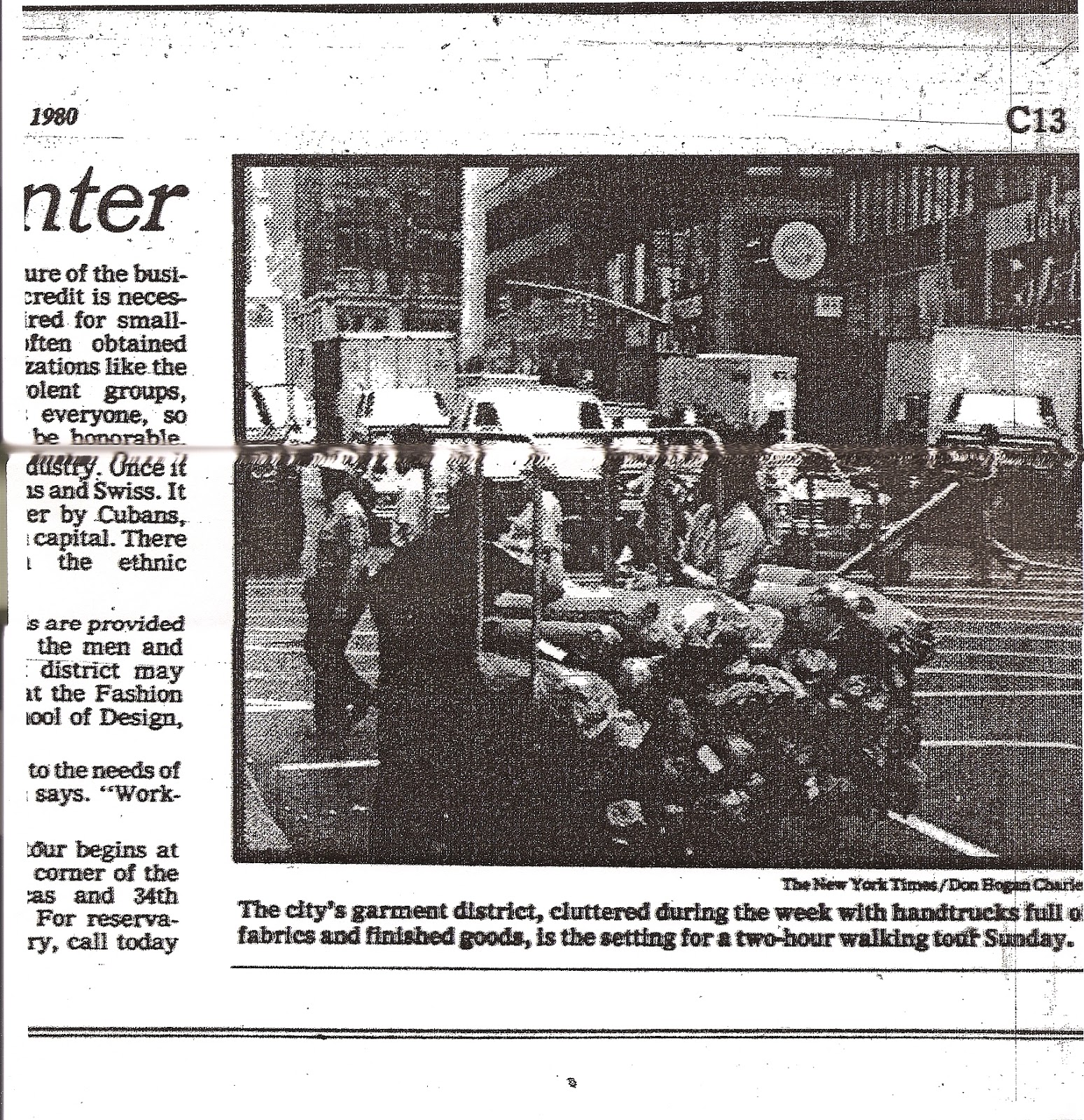
This picture comes from an article entitled "An Unhurried Walk in the Garment Center" by Jennifer Dunning. It is an interesting piece about a walking tour which was conducted in New York's garment district in 1980. Notice Dubrow's Cafeteria in the background - you can see part of the sign in the upper right corner.
Among other things, the article talks about how Dubrow's fit into the landscape of the garment district:
"The garment district is not only concentrated but also compartmentalized...'The district is more important as a display and distribution area than a major manufacturing area,' (James) Shenton saysm pointing up to a sooty Gothic-style emporium devoted largely to designer samples. 'Much of the manufacturing is done now in New Jersey, Pennsylvania, and North Carolina, though there is a revitalization of small-scale units of productions with the move back of Chinese to Chinatown and to Greeks to Astoria'...everything can be bought, it seems on Seventh Avenue, from "absolutely the best chocolate chip cookies in New York to holidays in Rumania.
On the corner of 38th Street alone, the fames Dubrow's Cafeteria and Lou Siegel's restaurant stand cheek by jowl with the Spanish Taverna. And each block has the most astonishing number of fast food restaurants, which suggests the enormous concentration of people here. A quarter of a million to 300,000 people pass through this area in the course of a normal workday."
(New York Times, Friday, July 11, 1980)
Tuesday, September 25, 2007
President Carter in front of Dubrow's

There's no article to accompany this image, but you can see that behind President Carter is part of the Dubrow's sign.
The caption for this article, which appeared on the front page of the Friday, October 31, 1980 edition of the New York Times, reads: "Carter ends New York Campaign. President Carter responding to union workers at rally in city's garment district."
Monday, September 24, 2007
A Cafeteria of Refinement
This is an ad from 1954. I didn't even realize Dubrow's advertised. Thanks to Marcia Bricker for this great find!

What's cool is now we also have a definitive answer as to when the King's Highway Dubrow's opened: 1939.

What's cool is now we also have a definitive answer as to when the King's Highway Dubrow's opened: 1939.
Sunday, September 23, 2007
Governor candidate stumps at Dubrow's
Well, it's been a long time since I updated this blog. I still have a couple New York Times articles left to post, but I finally made it to the Brookline Public Library, where I was able to track down a couple original copies on microfiche. The online New York Times archive wouldn't let me move the images in some of the articles, so I couldn't put them into a usable format to share here.

This one is of Hugh Carey, in front of the Manhattan Dubrow's. He was a Representative and a Democratic candidate for governor in 1974. The other photo is of another Democratic candidate (Howard J. Samuels) in Brooklyn. Excerpted from the accompanying article by Frank Lynn:
"Mr. Carey, for his garment center rally in front of Dubrow's Cafeteria at Seventh Avenue and 38th Street, had such leading Democrats as former governor Averell Harriman, former mayor Robert F. Wagner, and Mrs. Edith Lehman, widow of the Senator. Mr. Carey noted that Presidents Roosevelt, Truman, and Kennedy had spoken on the same site as candidates."
(New York Times, September 6, 1974)
But the title of the article is "Rivals for Governor Get Small Crowds" - apparently both candidates attracted very small limited numbers, and several people who did participate apparently did so negatively - they chastised Samuels for not allegedly not having paid his taxes. Hugh Carey won the Democratic candidacy and the election and went on to serve as governor from 1975 to 1982.
Anyone know more about Carey's statement about former presidents Roosevelt and Truman speaking in front of Dubrow's? I had only heard people recall seeing Kennedy in front of Dubrow's.
Friday, July 13, 2007
Recycling chairs
I know some Dubrow's items wound up on Ebay.
Apparently others were recycled into other restaurants. This comes from a 1988 article entitled "French bistros take all-American turn" by Joe Edwards.
"Like Restaurant Florent, the restaurant will be unpretentious and offer a good value, according to Morellet, who noted that dinner entrees would be priced from $7.75 to $13.50. But the decor is fancier--what Morellet called "high-style 1950s--a mix of contemporary and postmodern. Furniture includes the original cast aluminum chairs from the old Dubrow's Cafeteria, which closed several years ago."
(Nation's Restaurant News, Feb 8, 1988)
Tuesday, June 26, 2007
First jobs
Apparently, the children's author Bruce Farrington Coville worked at Dubrow's. According to this autobiography, his first job upon moving to New York City from Phoenix, NY was bussing tables at Dubrow's.
He doesn't say much more about what he thought about the job, but he has some interesting things to say about what it took to find a job in general in those days:
"I headed for New York City, figuring that since it was summer it would be off season for a tropical paradise and I would have no problem buying an airplane ticket to the islands. Wrong! As it turned out, I couldn't get a reservation for two weeks, though the airlines told me I could check on standby every day. (What I had really wanted to do was work my way down on a boat. But I got laughed at down at the docks, where they told me I'd have to join the union and unless I had a relative who was already a member, the waiting list was years long.)
Two strikes, and an important lesson for a writer: do your research! Having no intention of going home at this point, I was stranded in Manhattan. I went to the YMCA, where I got the cheapest room I could. In the lobby was a table where you could sign up for temporary work, and I took advantage of it, not wanting to draw down my little bankroll any more than necessary. I ended up washing dishes in a seafood restaurant, where I scrubbed away grease that seemed to have accumulated for years. They must have thought I did a good job because they gave me a fabulous meal in addition to my pay. The next night I got a job bussing tables at Dubrow's cafeteria in Brooklyn."
Wednesday, June 20, 2007
Still here...
It's been 2 months since I posted. Ugh. Life has sort of taken over. April and May were rough months - some family energencies and losses. But we're OK now.
I still have 1-2 more articles I downloaded from the New York Times archives, and this summer one of my projects is going to be to go to the public library and comb through the microfiche files to find some of the articles that downloaded incompletely. Plus, there's a couple longlost family members I need to sit down and write, so I can get more oral history testimonies.
Meanwhile, Marcia Bricker, whose fabulous photos have been featured here on this blog, tells me that she is in discussions about a documentary about Dubrow's. How cool would THAT be.
Sunday, April 29, 2007
Another Dubrow's review
I'm going to have to get to the library soon and check out some of the articles I downloaded from the New York Times archives in microfiche form. There seems to be a problem with some of the images, so I can't upload them all. I'm not sure if it's a copyright issue or a quality issue. But meanwhile, I found another review of Dubrow's, this one by Mimi Sheraton:
"Dubrow's Cafeteria, 515 Seventh Avenue near 38th Street (221-6777), is a classic, with larger-than-life dairy dishes, delicatessen sandwiches and steam-table food more or less Jewish - East European in style. Breakfast, lunch, and dinner prices are moderate. The best bets are the egg dishes, cold plates, sandwiches, and the vegetables with pot cheese and sour cream. Closed Sunday." (New York Times, August 8, 1980)
"Dubrow's Cafeteria, 515 Seventh Avenue near 38th Street (221-6777), is a classic, with larger-than-life dairy dishes, delicatessen sandwiches and steam-table food more or less Jewish - East European in style. Breakfast, lunch, and dinner prices are moderate. The best bets are the egg dishes, cold plates, sandwiches, and the vegetables with pot cheese and sour cream. Closed Sunday." (New York Times, August 8, 1980)
Monday, April 23, 2007
King's Highway ticket

This is another photo by the always amazing Marcia Bricker.
She writes:
"You took a ticket when you entered the restaurant on Kings Highway. There was a great ticket machine with a guy that handed you the ticket. Whenever you went up to the counter they punched the ticket with the amount you spent. If they punched $1.25 for a sandwich and later you went back for coffee, 25 cents and a danish, 60 cents - they
added on those amounts. Then Roz at the door added up your punches for your total bill. The maximum on this ticket was 3.40. If you used that up, rare in those days, you went and got a second ticket - I don't remember how they knew you had two tickets. Katz's deli uses a similar system - the last time I was there was last year."
Also, she is currently in conversation with some contacts she has about the possiblity of making a documentary about Dubrow's. How cool would that be? I am hoping this will spur me on to try and track down a couple relatives who knew Dubrow's well but with whom I am not regularly in touch, so I can do some more oral history.
Tuesday, April 17, 2007
Restaurant review
Found this in the Village Voice's NYC Guide:
"Diamond Dairy Restaurant, 4 W 47th St, New York, NY 10036, West Side
Phone: (212) 719-2694, Price: $
Jewish, 42nd to 59th, Restaurants - General, Restaurants
Dramatically poised on a balcony above the National Jewelers Exchange, this old-fashioned Ashkenazic Jewish dairy restaurant features the usual dishes including blintzes, puddings, and rivers of sour cream. Baked fish is a particular specialty, but even better is cholent, a garlicky bean stew. All hail the orange kugel floating on top! Enjoy watching the jewelry transactions down below as you dine, and go as soon as possible, before this New York institution goes the way of Dubrow's and Hammer's."
It sounds like it's a throwback to Dubrow's. I'll have to check it out next time I'm in NYC.
Tuesday, April 03, 2007
Dubrow family

This is a photo of the family of Benjamin Dubrow. The smallest child is Ruthie Dubow, which dates this photo to just a year or two after her birth. She is sitting on Benjamin's lap, and beside them is Sylvia, the next youngest. Sylvia went on to marry Irving Kaplan, my grandfather and an eventual manager and part owner of Dubrow's. Beside her is Rose Dubrow, Benjamin's wife. In the back row we have Lila, who would become the mother of Joe and Robert, who have both made appearances on this blog in comments and in the oral history I took last Passover. Beside Lila is George, Benjamin's only son. He was a manager of Dubrow's until his tragic early death, and also the father of Irwin Dubrow, who was also a manager of Dubrow's. Finally, the woman beside George is Minnie, who went on to marry Max Tobin. Both Max Tobin and his son, Paul Tobin, went on to be managers of Dubrow's.
Sunday, April 01, 2007
Seymour Gruber
Happy Pesach to everyone! I'm back down in Miami with my family, and got this little story from my cousin Steven Gruber. He recalled that his father, Seymour Gruber, was working as a young pediatrician in Brooklyn, and would make a lot of house calls. Of course, after inviting him into their homes, they would invariably want to feed him, and not wanting to be rude...he'd accept. They would bring him out some cakes, and then silverware with which to eat it...which was often Dubrow's silverware, pilfered from the restaurants...
Seymour also met his wife, Ruthie, through Dubrow's. Or rather, through Dubson's, which was a more upscale, traditional restaurant the family started for a short run. Apparently Seymour would come in a lot, and Irving Kaplan, my grandfather, told him one day he had to meet his sister-in-law. He introduced them, and they wound up getting married. According to Steven, Irving would tell people he "fell in love with Seymour first" when describing Seymour and Ruthies's relatationship.
Seymour also met his wife, Ruthie, through Dubrow's. Or rather, through Dubson's, which was a more upscale, traditional restaurant the family started for a short run. Apparently Seymour would come in a lot, and Irving Kaplan, my grandfather, told him one day he had to meet his sister-in-law. He introduced them, and they wound up getting married. According to Steven, Irving would tell people he "fell in love with Seymour first" when describing Seymour and Ruthies's relatationship.
Friday, March 30, 2007
Comparing Dubrow's to Bagel Nosh
In 1976, the New York Times published an article entitled "You Can't Judge a Bagel By the Decor Around It" about the new chain of bagel shops called Bagel Nosh. This Manhattan chain was apparently very successful - it spread as far away as California, and several copycat franchises popped up. It does not appear that the current California and Arizona company by the same name is related - according to their website they started in 1993.
In general the article is about Bagel Nosh, and not unlike some of the glowing descriptive articles written about Dubrow's at different times, but what I find very interesting is that the owner of Bagel Nosh compares his restaurant to Dubrow's:
"'If you look in here and compare our crowd to the people you see next door at Dubrow's,' (Thomas) Quinn said by way of explaining his Seventh Avenue and 38th Street location, 'you'll notice we get the women and girls while they get the rackpushers and more traditional garment district types.' Women, in fact, outnumber men at lunch in that location by about six to one and, in general, exhibit a sort of career girl fashion awareness in dress." (New York Times, August 31, 1976)
Sunday, March 18, 2007
Metropolitan Diary
That's title of what looks like an article in New York Magazine (November 22, 1976). It's written by Tom Buckley, and it's a piece about life in New York City. I find this quote about Dubrow's very interesting:
"The Governor, one of the landmarks of the Garment Center, closed last month...Well, you can still catch up on the gossip of the salesmen and the cutters at Dubrow's, on 38th and Seventh. Just tilt your chair up at an interesting table (that's your reservation) and go get your soup."
I didn't know about tilting your chair up. It's those little details I love to hear.
Sunday, March 11, 2007
George Dubrow (1903-1956)
Found the list of obituaries offered for George Dubrow, who was manager of the Manhattan Dubrow's until his tragic, early death in a car accident:
"DUBROW - George. beloved husband of Fannie; devoted father of Irwin, Helene, and Leonard, loving son of Benjamin and Rose Dubrow; dear brother of Minnie Tobin, Lila Adler, Sylvia Kaplan, and Ruth Gruber. Services Wednesday, 1:30 PM, "The Riverside", Brooklyn, Ocean Parkway and Prospect Park. In lieu of flowers, contributions can be made to the Heart Fund or the Nephrosis Foundation.
DUBROW - George. Local 325 Cooks, Countermen, Soda Dispensers, Food Checkers Cashiers, and Assistants Union, its officers and members, mourn the loss of George Dubrow, employer of our members. A person of deep integrity, gracious charity, and liberal intent, his will be an enduring monument in the history of man's humanity to man. We express our sincere sympathy to the bereaved members of his family. May his soul rest in peace.
HARRY DALLES. President
ABE SILVERSTEIN. Secretary-Treas.
DUBROW - George. The Utica Parkway Street John Merchant's Association extends its heartfelt condolences to the Dubrow family. The good name of George Dubrow will long be remembered by his fellow merchants and the community.
BERNARD KESSNER, President.
DUBROW - George. The employes of Dubrow's Cafeteria mourn with deep sorrow the sudden and untimely passing of their beloved employer and friend, and extend to his bereaved family their sincere and heartfelt sympathy.
DUBROW - George. The Board of Trustees of Beth-El Hospital notes with sorrow the sudden passing of our dear friend and benefactor. Our sincere condolences to his bereaved family.
BENNE KATZ, President.
DUBROW - George. The Officers and Directors of the Chronic Disease Hospital note with deep regret the passing of George Dubrow. Heartfelt condolences to the bereaved family.
ISAAC ALBERT, President.
DUBROW - George. Temple Beth-El, Rockaway Park, sorrowfully announces the passing of its devoted member. Members please attend services.
JAMES J. WOLFSON, President.
DR. NATHAN KAPLAN, Secretary."
It is an indicator of how important George was to the community that his obituary was the only one with multiple listings.
Sunday, March 04, 2007
Richard Peck quote
Author Richard Peck wrote an article for the New York Times about Brooklyn, and Dubrow's gets a mention:
"If Flatbush has a southern frontier, it is King's Highway. The commerce along Flatbush Avenue is beginning to go to seed, but King's Highway is a vital retail area. There is the London Fruit Market and the 1940's glamour of Dubrow's Cafeteria. There is Perlson's for men's wear, featuring pearl-buttoned denim for Brooklyn cowboys."
(New York Times, April 29,1973)
The end of the article mentions his book Dreamland Lake, which may relate in someway to the article, which is a nostalgic/historical piece. But it is one of a series of articles that document the changes beginning to take place in Brooklyn, of which Dubrow's was a part.
Friday, March 02, 2007
Sandy Koufax at Dubrow's
Excerpted from The Dodgers: 12 Years of Dodgers Baseball by Glenn Stout:
"Sophomore year, Koufax returned to Cinncinnati with a $20,000 Dodger offer and a dilemma. "He wanted to know what I thought, because, you know, Jews don't do that," Rothenberg remembered. I said, "Sandy, if these guys think you're that good that they're offering you that kind of money, take it. You can always go back to college." That was the last time I talked to him. Then he was just gone.
The day he signed with the home team, Marv Raab saw him standing outside Dubrow's Cafeteria in Brooklyn, a lanky kid in a Lafayette sweatshirt, telling the world, "I just signed with the Dodgers!" He seemed as surprised as everyone else."
The same quote from Marv Raab is also excerpted in Sandy Koufax: A Lefty's Legacy by Jane Leavy, though I'm not sure which book came out first.
Tuesday, February 20, 2007
Leo Martin in the news again
Very interesting. A year later, Leo Martin shows up in the New York Times again, but this time with the headline: "Four Food Dealers Held as Bribers."
"Operators of a cafeteria and three bakeries were arrested yesterday on charges of offering bribes to health inspectors to avoid the notoriety of appearing on the "dirty restaurant list" that warns the public of health violations, according to the complaint." (New York Times, November 17, 1971)
Apparently, at four different restaurants, the owners offered between $10 and $50 to inspectors in order to avoid flunking their food inspections. The deputy commissioner at the time, David Dorsen, was quoted as saying that this is the first time charges have been pressed against anyone attempting to offer bribes, and the law making restaurants who don't pass inspection public went into effect in July of 1971. It sounds like this was a case of setting the standard for other restaurants - i.e. take this seriously, don't try and buy your way out of these new regulations.
What's interesting, though is that it goes on to mention that all the restaurants had previously come up with a clean inspection:
"Previously, the four businesses cited, including Dubrow's, the popular cafeteria in the garment district, had been given clean bills of health, with no ciolations (sic) cited by H.S.A inspectors, who are known as "sanitarians," Mr. Dorsen said....The four men arrested and charged with bribery and giving unlawful gratuities were identified as Leib Braunfeld, 52, of Gertel Bakery, 53 Hester Street, charged with a $10 bribe offered on November 3; Herb Geller, 26, of Original Royal Bakery, 237 West 72nd Street, charged with offering a $20 bribe on November 13; Leo Martin, 56, of Dubrow's Cafeteria, 515 Seventh Ave, charged with offering a $50 bribe on November 14; and Adolph Mersberg, of Mersberg Bakery, 64-00 Metropolitan Avenue, Queens, with the complaint listing a $10 bribe offered on October 25. " (Ibid.)
It was probably a pretty minor incident, in the grand scheme of things, but it does raise some questions - why would Dubrow's not pass that year, when previously it had? Is it just a coincidence that it comes a year after Leo Martin's big push for increased productivity, or did he sacrifice some standards to get there?
Saturday, February 17, 2007
"Dubrow's is no ordinary cafeteria"

In this article, about a year after the death of Irwin Dubrow, we find out what happened to the Manhattan Dubrow's that Irwin ran for many years:
"Leo Martin got in an awful rut a while back. Like any other businessman in this inflationary era, his costs were galloping upward and his profitability - indeed the very existence of the cafeteria he operates at 515 Seventh Avenue and 38th Street - was threatened. This was no small matter to him because he not only operates Dubrow's cafeteria in the garment district, but since last October he has owned 30 percent. "Every time my costs went up, I would try and pass it on to the customer. Each time I raised my prices, I served fewer and fewer customers," he explained.
Business dropped from 5,500 customers a day to somewhere between 4,300 and 4,600 by the third week in May. We were starting to lose money for the first time since I took over full management last October on the death of the grandson of the founder," he said. "
(New York Times, October 26, 1971)
The article goes on to give us a good detail about Mr. Martin, as well as the history of the changes in owners and managers over the years:
"The other Dubrow cafeteria, at King's Highway and East 16th street, is owned by a relative of the founders. It's a separate business. Mr. Martin was no newcomer to the business. He began as an assistant manager in the Dubrow cafeteria on King's Highway in 1939. He had been general manager successively of three Dubrow cafeterias, the last one being the Seventh Avenue one. He left Dubrow's in 1959 to become general manager for the Arthur Maisel restaurants. When the Maisel restaurants liquidated, the Dubrows asked Mr. Martin to come back. That was in October, 1968, and he's been there ever since. " (Ibid.)
The article is not just a character piece about Leo Martin, however, as it goes on to try to understand the realities facing the cafeteria in New York City:
"Mr. Martin was not only in a restaurant where business was falling, he was in an industry that failed to adjust. At one time, there were perhaps 300 cafeterias in the city as big as the Dubrows Seventh Avenue one - it seats 450 - now there are 25 of them and many are in trouble.
"I realized the fact that the cafeterias had outpriced themselves and were not competitive with the average man's eating place, " Mr. Martin recounted. "Hamburger stands, pushcarts in the street, small coffee shops, and even some medium-priced restaurants were all outselling us."
It was easy for Mr. Martin to fall into the trap of raising prices. Dubrow's is no ordinary cafeteria. At dinner, a dessert cart serves the tables directly. The pastries on that cart art all produced on the premises. Dubrow's employs 11 bakers who make Vienna rolls, stangell, a salt stick, pletsl, a thin crisp roll garnished with on-" (Ibid.)
Here the article continues on another page that is apparently not included in the download. But it picks up shortly thereafter and explains how Leo Martin helped Dubrow's survive when other cafeterias were faltering:
"...Mr. Martin naturally expected to get good prices. Yet the fact remained that, while quality was high, the customers just weren't coming into the restaurant.
Of all things, New York City's extending of a 7 percent sales tax to meals below a dollar proved to be fortuitous. The customers resented it naturally, and this didn't help business. Mr. Martin, a 55-year-old slim man with wavy black hair and a mustache, knew he had to do something drastic to regain his business. It wouldn't be easy. The garment district, in which the restaurant was centered, had become more and more depressed...He decided to use one of the oldest gimmicks in merchandising - the loss leader. What's more, he tied it to the 7 percent "hot dog" tax, as the levy, which starts at 15 cents, has been called.
He explained: "We decided to absorb the 7 percent tax on a selected list of specials on which we reduced our prices substantially. For example, a hamburger and coffee at lunch, which used to bring $1.02 including the 7 percent tax, we now featured for 69 cents."
...This kind of special is enough to make any restaurant man apprehensive. Mr. Martin admits that, if his customers bought nothing else, the specials would put him out of business. It didn't work that way - about 25 percent of the customers are ordering specials - and it almost never does, he explained..."We have reacquainted old and new customers with Dubrow's and our tremendous selection of food. Consequently, we have people coming in daily who eat the special once a week or twice a week - but not all the time. The rest of the week, they buy regular items." (Ibid.)
Essentially, Dubrow's saved itself for another decade and a half, while other cafeterias were closing, by building on its strength - loyal customers.
"The reason production is so important to Dubrow's is that an establishment as big as this must have a large basic production crew. The solution was increase dollar volume without increasing the payroll. When the specials began on September 22, volume soared immediately, Mr. Martin said, adding: "We're now serving about a thousand customers a day more than we did before the loss leaders. Our average day - we're open 16 hours, until 10 PM, we serve breakfast, lunch, and dinner - brings in between 5,500 and 5,600 customers a day"..." (Ibid.)
Mr. Martin goes on to crunch the numbers - I presume this article was written for the business section of the New York Times, as it has a decidedly business feel. I also imagine that the publicity garnered from the article didn't hurt business, either, so that was a good business move as well. He also goes on to note that not all the employees were so happy about the changes, as for them, it meant more work and not any more money.
Friday, February 16, 2007
Irwin Dubrow
Among the articles about Dubrow's I found in the New York Times database, I also found Irwin Dubrow's obituary. In the copy available to download, it looks like part of the header has been cut off. It reads "Irwin Dubrow, 39, Dead;" and the presence of the semicolon indicates more text, as do the stray black marks found underneath. But mostly it's just white space, so I don't know what the rest of the header read.
The obituary goes on to report his death, with no mention of how he died:
"Mr. Dubrow headed Dubrow's, which operated a cafeteria at 515 Seventh Avenue, near 39th street, and another on 35th street off Seventh Avenue. He also operated Alfie's a bar and grill at Third Avenue and 74th Street, and a restaurant on King's Highway in Brooklyn.
He was a director of the Karen Horney Clinic and a director of Affiliated Restaurateurs, Inc.
He leaves his wife, the former Ann Tuck, two daughters, Joanne and Barbara, a sister, Mrs. Helene Grossman, and his mother, Mrs. Fannie Dubrow Rubin. "
(New York Times, October 6, 1970)
A little backstory: Irwin Dubrow, who was the grandson of Benjamin Dubrow, killed himself. I am guessing that that is what is in the rest of the headline, though I am not sure if it was intentionally blotted out. I know that Dubrow's was closed for a little while following his suicide, which is understandable since it was a family crisis, both personally and in terms of the business.
I did not, however, know that there was another cafeteria owned by the family in Manhattan, nor did I know how many different jobs Irwin was doing at once. Was the "other restaurant" on King's Highway actually Dubrow's? Or did the family own a different restaurant on King's Highway later on? And Karen Horney clinic? Does that mean he was a social worker on top of being a businessman? I know Joanne, his daughter, has chimed in on this blog at times, so perhaps she will add some of her thoughts. Also, Irwin left behind another brother, Leonard, who for unknown reasons is not mentioned in the obituary.
Wednesday, February 14, 2007
End of another New York cafeteria
Continuing the theme of understanding the demise of New York City's cafeterias, I found this article about the closing of another cafeteria, Garfield's, which was located at the corner of Flatbush and Church Avenues in Brooklyn. According to the article, it officially close on July 6, 1971, "after declining business had forced its demise."
The article goes on to reference the Dubrow's on Eastern Parkway:
"Garfield's, in its heyday, was known throughout Brooklyn, mentioned in the same breath with Dubrow's on Eastern Parkway and Utica Ave and Hoffman's on Pitkin and Saratoga Avenues, which are also gone."
(New York Times, July 25, 1971)
Monday, February 12, 2007
Foreshadowing the end of Dubrow's
I found an article by Murray Schumach in the New York Times that talks about the decline in New York's cafeterias. It was written in 1969 - which is interesting to note because it means problems started for the cafeteria business quite early on. It also means Dubrow's survived the decline for a decade and a half, much longer than others in the city. Schumach writes:
"Affluence has already cannibalized more than two-thirds of those mirrored citadels that became symbols of the city and transferred the tempo of the subway to the stomach." (New York Times, August 18, 1969)
He goes on to quote customers and the owners of the Governor Cafeteria and the Belmore Cafeteria before talking about Dubrow's:
"And at Dubrow's, an equally successful cafeteria at Seventh Ave and 38th Street, the owner, Irwin Dubrow, grandson of the founder of the business, says: "A cafeterial can't pass along increased prices and wages the way other eating places do. A couple years ago we raised our price of coffee from 10 cents to 15. We were only doing what everybody else was doing. But we lost 1,500 customers a day and we still haven't gotten them all back."" (Ibid.)
He goes on to reference two Hector's Cafeterias, Garfield's, Dixon's, the King's Highway Dubrow's, the 167th Street Cafeteria, and the Concord as other currently surviving but struggling cafeterias. He doesn't reference the Eastern Parkway Dubrow's - I don't know if this means it had closed by now, or what.
He also interviews a customer in the Manhattan Dubrow's later in the article, and mentions Leo Martin, who came up earlier on this blog because his obituary mentioned working at Dubrow's:
"One recent afternoon, in the Manhattan Dubrow's, Charles Abbott, a salesman, was asked as he sat squeezed at a table among two strangers, why he liked cafeterias. He replied, "You get out quick. The price is right. And with such an output, you never get a stale sandwich."
Leo Martin, an executive at the cafeteria, says that a study showed that during the lunch hour the average customer was out in 19 minutes. At The Governor, the calculations show that...each of the 426 seats is turned over seven times between noon and 2 PM." (Ibid)
What's interesting about this is that it contradicts some of what readers have shared about liking so much about Dubrow's - the ability to "plunk down a quarter for a cup of coffee and sit all day" as my great-aunt Marian said.
Wednesday, February 07, 2007
Dubrow's as a community center
I found two articles from the 1960's, both of which reference Dubrow's as a center of political and community life in Brooklyn. The first one is about the Patrolmen's Benevolent Association rallying the community to vote 'yes' to eliminate the Civilian Complaint Review Board, claiming that "the existence of the board prevents policemen from taking appropriate action to fight crime." (New York Times, October 24, 1966) Apparently the language of the ballot measure was sufficiently confusing, because the article goes on:
"A yes vote bars civilians from serving. Thus anyone favoring the present board must vote no to support it. This produced bewilderment. In front of Dubrow's Cafeteria on King's Highway at 16th street, a campaign worker spoke in a mixture of Yiddish and English in an effort to clarify things for an elderly man."
This campaign hit up all the stops in Brooklyn - the article goes on to say that they made stops at Trump Village shopping center in Brighton Beach and Nathan's Famous before coming to Dubrow's, and from Dubrow's they planned another stop at the Brighton Beach Baths. The article also references a politician named Lindsay and blames much of the current political issues on him.
Two years later, Lindsay, who it turns out was the mayor at the time, is also booed in front of Dubrow's:
"At King's Highway and East 16th street in Brooklyn, the crowd was so vehemently anti-Lindsay over the school strike that (Senator Jacob) Javitz, a master at soothing angry crowds, said several times that there was no point in continuing since he could not be heard, even with a microphone.
"The Mayor is in a tough spot - it may even be his own fault," the Senator told a crowd that including angry teachers and parents outside Dubrow's Cafeteria. But just as he is jeered today, he may be cheered tomorrow.""
(Tolchin, M. "Lindsay Backlash Confronts Javitz." New York Times, October 17, 1968)
Anyone remember these particular political events? The theme is consistent with memories people have shared earlier on this blog about the King's Highway Dubrow's being a popular place for politicians to stump.
Monday, February 05, 2007
Private Investors Start Parking Garage

The Times article cuts off, so other then in the photo there's no explicit reference to Dubrow's. It would seem to me that this would have been in the very early years of the Manhattan Dubrow's - in fact, it might even be the initial plans for that location. I'm not sure.
Also, it would seem to me that this is a premonition of the demise of Dubrow's - after all, even though Dubrow's served the garment workers in Manhattan for many years, I suspect the 400 car garage was not built for them, and so the need for such a construction suggests that even as early as the 1950's the face of Manhattan was beginning to change.
Subscribe to:
Posts (Atom)